America’s Maritime Renaissance – A Blueprint for Restoring American Maritime Leadership
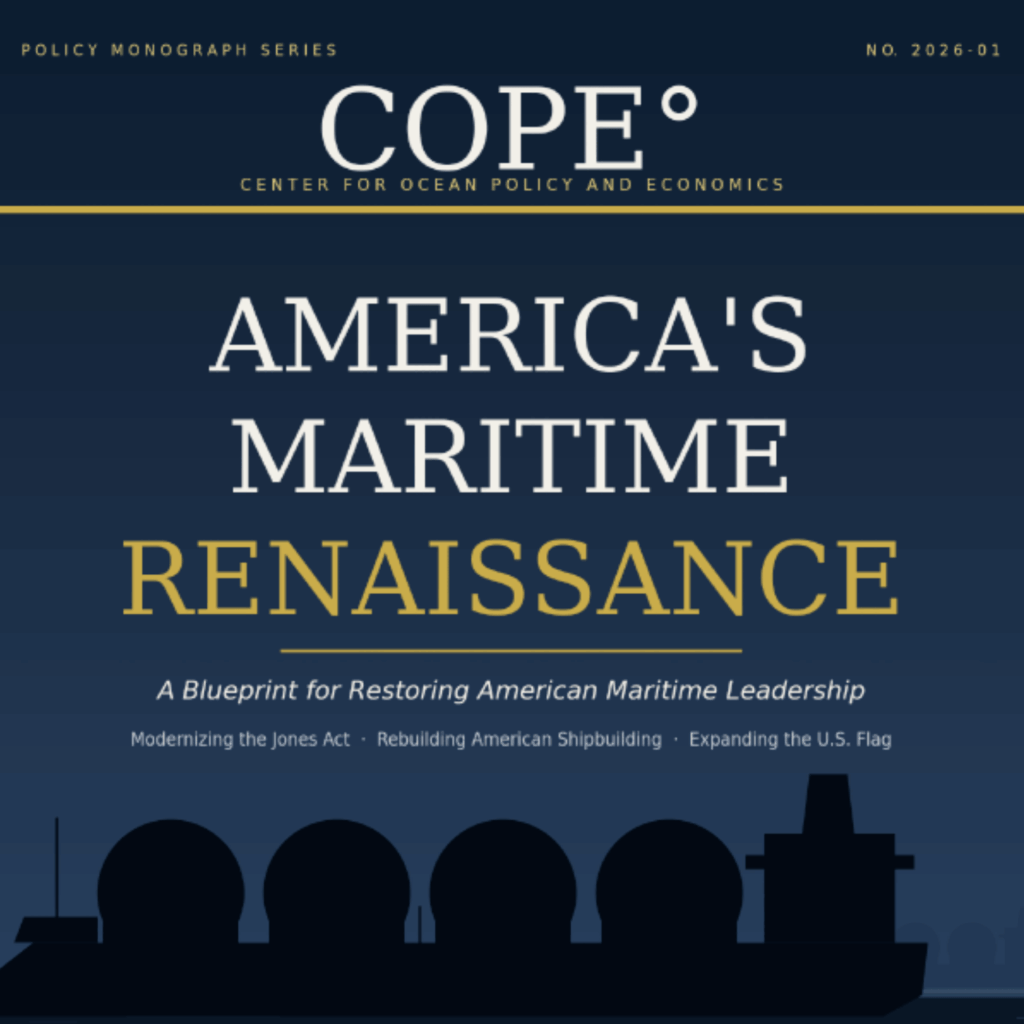
AMERICA'S MARITIME RENAISSANCE
A Blueprint for Restoring American Maritime Leadership
Modernizing the Jones Act – Rebuilding American Shipbuilding – Expanding the U.S. Flag
Written by
Eric R. Dawicki, MPA
22 September 2026
The Center for Ocean Policy and Economics (COPE°) at Northeast Maritime Institute has published America’s Maritime Renaissance: A Blueprint for Restoring American Maritime Leadership, a policy monograph proposing that the United States rebuild its commercial shipbuilding capacity and expand the American flag in international trade while preserving the Jones Act’s core protections.
The 49-page monograph, written by Northeast Maritime Institute president Eric R. Dawicki, departs from the familiar framing of American maritime policy as a binary choice between defending the Jones Act as written and repealing it. It argues instead that the statute’s flag, ownership and crewing requirements should be preserved in full, and that the single component current U.S. industrial capacity cannot support — where a hull may be built — should be modernized on a temporary, tightly controlled basis.
The case for urgency rests on federal findings. Executive Order 14269, Restoring America’s Maritime Dominance, signed April 9, 2025, states that the United States constructs less than one percent of commercial ships globally, while the People’s Republic of China produces approximately half. Separately, the Maritime Administration’s Maritime Workforce Working Group found that sustaining both the commercial U.S.-flag fleet and military sealift would require 13,607 mariners holding unlimited credentials against a pool of 11,768 — a deficit of 1,839.
“The Jones Act was never intended to preserve a single industrial process. It was intended to preserve American maritime strength,” said Eric R. Dawicki, president of Northeast Maritime Institute and founder of COPE°. “When a policy stops producing the ships, the shipyards and the mariners it was written to produce, loyalty to its purpose requires us to modernize its mechanism. That is not an attack on the statute. It is the most serious defense of it available.”
Seven Pillars, and Draft Legislation to Match
The monograph advances seven recommendations rather than a long list: preserve the Jones Act’s core protections; authorize a Trusted Allied Shipyard Certification Program permitting construction of Jones Act-eligible vessels at certified shipyards in allied nations while domestic capacity is rebuilt; require every such vessel to carry a growing American industrial commitment until the authority sunsets; modernize maritime personal-injury law; expand the American flag internationally through a U.S. Virgin Islands open registry; strengthen the maritime workforce pipeline; and establish a National Maritime Strategy Council reporting to the President.
Three appendices contain draft legislative text — a Trusted Allied Shipyard Certification Act, a National Maritime Strategy Council Act, and a framework for the USVI registry — written so that congressional staff can work directly from them. The certification program would exclude China and other strategic competitors by statute rather than by administrative discretion, require joint approval by five federal departments, and terminate on a defined schedule as domestic shipyard capacity is restored.
An American Flag Option With International Precedent
The monograph’s most distinctive proposal is a U.S. Virgin Islands open international ship registry operating alongside, not in place of, the traditional U.S. flag and the Jones Act coastwise fleet. It grounds the idea in two working precedents: Norway’s International Ship Register, created in 1987, which competes internationally for tonnage while a provision of its enabling act bars registered ships from carrying cargo between Norwegian ports; and Portugal’s Madeira International Shipping Register, established in 1989, whose vessels fly the Portuguese flag under Portuguese law and hold Paris Memorandum of Understanding White List standing.
“Norway and Portugal both solved a problem we have not,” Dawicki said. “They built internationally competitive registries without touching their own cabotage trades, and they did it at a standard high enough that the international labor movement does not call them flags of convenience. A Virgin Islands registry would bring ship finance, insurance, classification, and maritime technology work into American jurisdiction — and it would do it without moving a single Jones Act vessel.”
Written to Be Checked
The monograph carries a full footnote apparatus organized in three tiers — primary legal authorities, government sources, and international and industry data — and states openly which citations have been verified against primary sources and which remain outstanding. It was subjected to an internal adversarial review before publication, conducted as though the reader were a governor’s workforce office, congressional staff, a federal grant reviewer, or a competing vendor.
“A policy document meant to support legislative drafting is only as credible as its weakest citation,” Dawicki said. “We would rather tell a reader plainly what we have confirmed and what we have not than have a staffer find it first.”
A Deliberately Nonpartisan Proposition
The monograph frames its recommendations for audiences across the political spectrum, arguing that the proposal asks Washington to connect workforce and industrial investments the United States already makes rather than to build a new federal bureaucracy. Its closing section states that preserving American maritime strength now requires rebuilding the entire ecosystem — ships, shipyards, mariners, capital, technology, and the international footprint of the flag itself.
About the Center for Ocean Policy and Economics
The Center for Ocean Policy and Economics (COPE°) is the maritime policy research center of Northeast Maritime Institute in Fairhaven, Massachusetts. COPE° conducts research and develops policy proposals on maritime safety, security and environmental protection, including workforce development, vessel registration, shipbuilding capacity, and the economics of the American maritime industry and the International maritime industry. In 2022, COPE° entered into an agreement with the Government of the United States Virgin Islands to pursue development of an international, U.S.-affiliated open ship registry domiciled in the territory.
About Northeast Maritime Institute
Northeast Maritime Institute provides maritime education and professional training through classroom instruction, simulation, practical training, sea-service experience and digital learning. In 2026 the U.S. Maritime Administration designated NMI a Center of Excellence for Domestic Maritime Workforce Training and Education under 46 U.S.C. § 51706. At the center of the Institute’s mission is a single principle: Honor the Mariner.
For questions or comments, please email [email protected].

America’s Maritime Renaissance – A Blueprint for Restoring American Maritime Leadership Read More »