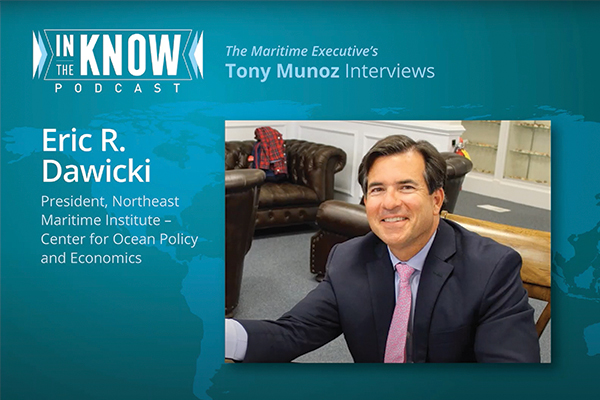
The Maritime Executive Podcast – Eric R. Dawicki on Creating a USVI Registry
The Maritime Executive Podcast – Eric R. Dawicki on Creating a USVI Registry Read More »
29 March 2022
IN THE KNOW PODCAST 38: Eric R. Dawicki on Creating a USVI Registry
Listen to the Maritime Executive’s #InTheKnow podcast’s conversation between Editor-In-Chief Tony Munoz and Eric R. Dawicki, President of Northeast Maritime Institute – Center for Ocean Policy and Economics. In this conversation, Munoz and Dawicki discuss Northeast Maritime Institute – Center for Ocean Policy & Economics’ agreement with the United States Virgin Islands to develop and manage the first open international ship registry of the United States – the USVI Flag 🇻🇮 !
The Maritime Executive Podcast – Eric R. Dawicki on Creating a USVI Registry Read More »

10 March 2022
FOR IMMEDIATE RELEASE
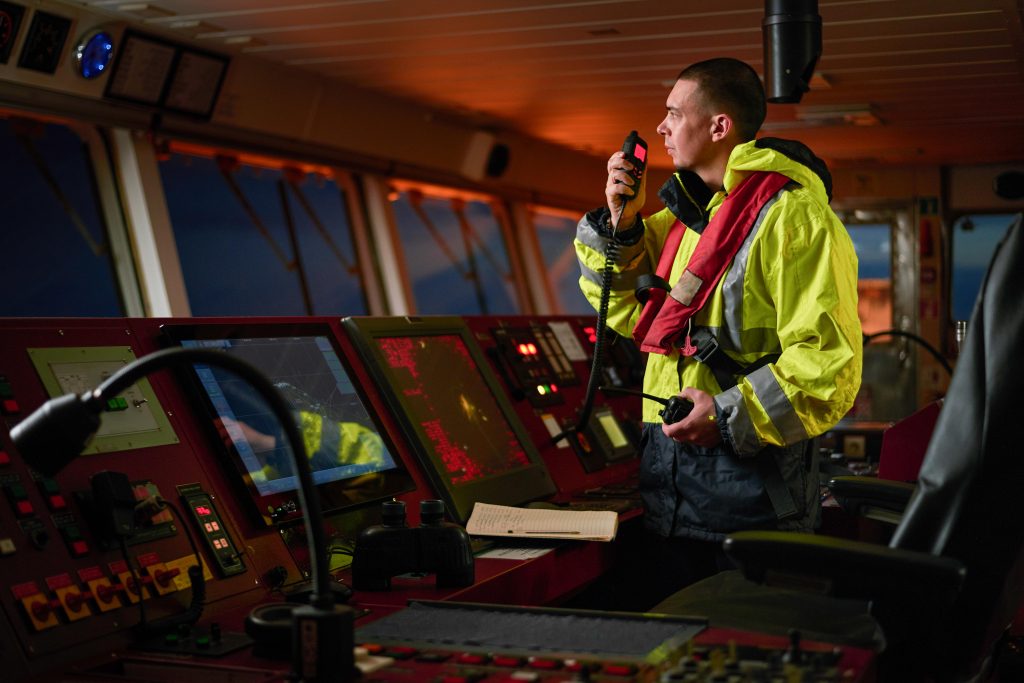
COPE° FORMS WORKING GROUP ON PSYCHOLOGICAL SAFETY AND SEXUAL ASSAULT AND HARASSMENT IN THE MARITIME SECTOR
Fairhaven, MA – The Center for Ocean Policy and Economics (COPE°) has announced the formation of an informal Working Group to develop projects designed to provide solutions to build on an international framework which supports a psychologically safe workplace culture for mariners. It is universally recognized this will have a positive effect on operational safety and security on board ships. Psychological safety is essential to the successful integration of vulnerable and marginalized groups in support of diversity, equality, equity, and inclusion.
The working group will support the work outlined in document MSC105/16/4 of the IMO Maritime Safety Committee as proposed by Dominica, Turkey, Saudi Arabia, InterManager, IIMA, ICHCA International, IFSMA, and AMPP. The submission presents suggestions to amend IMO Model Course 1.21 – Personal Safety and Social Responsibility, which will be discussed by the Maritime Safety Committee in May 2022. Its intention is to develop and deliver relevant actions and impactful solutions, using the UN framework to do the work and connect the industry to objectives.
“It is critical that the IMO quickly develop and implement guidance for programs which address the psychological welfare and safety of today’s mariner, as well as establish guidelines on sexual assault and harassment in the maritime workplace” stated Eva Lianne Veldkamp, IMO Policy Coordinator for the Commonwealth of Dominica Maritime Registry who is leading this effort. “While a lot of talk has been created surrounding these issues, there have not been many policy changes or meaningful actions taken towards supporting Psychological Safety and SASH in maritime. This working group is a great opportunity to translate talk into action.”
The working group welcomes committed maritime government, non-government, corporate, education, science and technology experts and partners to collaborate on developing and delivering relevant actions and impactful solutions to join in their work. Initially, they will be reviewing and suggesting amendments to existing IMO model course 1.21 – PSSR based on the proposals identified in document MSC105/16/4, submitted to IMO Maritime Safety Committee. They will also be evaluating training options, as well as harmonizing best practices and guidance documents amongst United Nations bodies (IMO and ILO); NGO diversity manuals such as ICS, WISTA, ISWAN, BIMCO, INTERTANKO, INTERCARGO and the World Shipping Council as well as industry resources and studies.
It is anticipated that future work of the group will include:
Organizations and individuals who would like to join the working group are encouraged to reach out to Ms. Eva Lianne Veldkamp at [email protected]
###
About Northeast Maritime Institute
Northeast Maritime Institute (also called NMI) is a private, coeducational, maritime college offering an Associate in Applied Science in Nautical Science degree. Established in 1981, Northeast Maritime Institute is the only private maritime college in the Commonwealth of Massachusetts. The college was originally established to provide an alternative to traditional education and training, with an emphasis on preparing mariners for employment. Graduates receive an Associate degree and are eligible to receive a United States Coast Guard Masters license upon graduation. Northeast Maritime Institute has trained over 70,000 mariners since 1995.
About COPE
The Center for Ocean Policy and Economics (COPE) is hosted by the Northeast Maritime Institute – College of Maritime Science: Created to tackle some of the ocean’s “wicked problems.” A culmination of years of extensive research and conversations with leading experts in the maritime and ocean related fields, COPE is a facilitator for cogent maritime and ocean policy and economic development project initiatives linking academic, corporate, non-governmental, and governmental partners to create impactful solutions. Additional information can be found at COPE.
1 March 2022
FOR IMMEDIATE RELEASE
GROWING, TRAINING AND PROTECTING THE MARITIME WORKFORCE CORNERSTONE OF US MARITIME REVITALIZATION PLAN
“Change is not a threat but an opportunity”
WASHINGTON, DC – A landmark Revitalization Plan for US Maritime Trade, Commerce and Strategic Competition that was launched earlier this month in Washington, DC contains, at its core, a commitment to growing, training, focused on protecting and growing the maritime workforce. With provisions for increasing jobs for mariners, providing education and training resources, and policies designed to enhance their security and safety, the plan is clearly a benefit for workers and the US maritime industry.
“We have witnessed an industry that has fallen dramatically over the last couple of decades,” observed Eric R. Dawicki, President of Northeast Maritime Institute, the sponsor of the plan. “We have not witnessed it more so than the last two years with the pandemic being so rough on our maritime trade and commerce. What we’re hoping, what we’re truly hoping, is that all of the relevant stakeholders come together and work together to make this a reality.” At the launch of the Revitalization Plan, President Dawicki stated: “We gather here today as an interested maritime community, as American citizens and as a collective body of people who care deeply about the maritime industry. We are guided by the creed ‘to honor the Mariner’ and to give back to an industry that has provided wealth and prosperity to our nation throughout the centuries.”
A Revitalization Plan for US Maritime Trade, Commerce and Strategic Competition was developed by a team of Distinguished Fellows at the Northeast Maritime Institute – Center for Ocean Policy and Economics (COPE) and advised by an array of leading thinkers in the maritime industry. Key elements of the plan include formation of the U.S. Virgin Islands’ open international ship registry—the first, and only, international U.S. open ship registry. The plan also includes establishing and implementing a green shipping strategy, including decarbonization of the U.S.-flagged fleet and modernization of the maritime workforce by deploying state of the art education and training tools in the US and abroad.
“This registry will protect all Merchant Mariners sailing on USVI Flagged vessels, including their legal, physical, and human rights’ asserted Dawicki. This flag will allow mariners from countries approved by OFAC to participate and find employment. However, we also want to excite US Mariners to work on USVI vessels by providing the right working conditions, competitive wage scales and realistic health and welfare standards to ensure long-term commitment across the board. The vision is to provide additional jobs and therefore help expand the US labor pool, not to compete in any manner with existing US jobs and industry.”
The plan to create a US flag open registry has been met with resistance from a coalition of US maritime unions currently making up approximately 18% of the maritime labor pool within the domestic United States. The Unions ho historically object to changes to the status quo and expressed concern that US mariners will be adversely affected. In response, Dawicki stated “The Revitalization Plan is the most progressive plan regarding maritime job creation and workforce development in three or four decades. We stand by the plan as it thoughtfully increases opportunities that are long term and sustainable for economic development through short sea shipping initiatives that will be enabled through the transshipment hub.”
Observed Captain Anuj Chopra, Co-Founder of ESGPlus: “I think the seafarers are excited about this plan as there is a strong welfare element. We want diversity, equity, and inclusion as an entry point into the system and strong policies against SASH.”
###
Go to US Maritime Revitalization Plan Launch to view the full event.
About Northeast Maritime Institute
Northeast Maritime Institute (also called NMI) is a private, coeducational, maritime college offering an Associate in Applied Science in Nautical Science degree. Established in 1981, Northeast Maritime Institute is the only private maritime college in the Commonwealth of Massachusetts. The college was originally established to provide an alternative to traditional education and training, with an emphasis on preparing mariners for employment. Graduates receive an Associate degree and are eligible to receive a United States Coast Guard Masters license upon graduation. Northeast Maritime Institute has trained over 70,000 mariners since 1995.
About COPE
The Center for Ocean Policy and Economics (COPE) is hosted by the Northeast Maritime Institute – College of Maritime Science: Created to tackle some of the ocean’s “wicked problems.” A culmination of years of extensive research and conversations with leading experts in the maritime and ocean related fields, COPE is a facilitator for cogent maritime and ocean policy and economic development project initiatives linking academic, corporate, non-governmental, and governmental partners to create impactful solutions. Additional information can be found at COPE.
Mariners are the cornerstone of new US maritime revitalization plan Read More »
17 February 2022
FOR IMMEDIATE RELEASE
US NATIONAL SECURITY AT RISK WITH TODAY’S MARITIME CONFIGURATION
New USVI Open Registry Provides Security Assets and Jobs
WASHINGTON, DC — The launch of a new United States open registry in the Virgin Islands will give the United States additional resources for protecting our nation, learned attendees to the launch on February 1st of A Revitalization Plan for US Maritime Trade, Commerce and Strategic Competition. Included in the plan were the new registry, a transshipment hub planned for the Virgin Islands, a Maritime Venture Capital Fund, green shipping strategy, modernization of the maritime workforce and the development of multilateral partnerships on maritime issues. Keynote presenters highlighted the need for shoring up U.S. maritime vulnerabilities both at home and abroad.
Opening the event, Morgan G. Dawicki, Project Manager for Northeast Maritime Institute, stated: “There is no question that our world is growing increasingly volatile, uncertain, complex, and ambiguous. We, the United States, are faced with the challenge to adapt and to continue to promote a rules-based international order. We are faced today with a U.S. maritime industry in decline over the past 75 years, while other nations are investing heavily in growing their maritime portfolios. We are the largest trading nation in the world, and yet control less than a percent of the world’s commercial tonnage. The economic and national security benefits from becoming more competitive in maritime trade and commerce are enormous.”
Speaking at the event was former Deputy Secretary of State, Ambassador John Negroponte: “As the first Director of National Intelligence, you can therefore imagine that national security and U.S. competitiveness are among my greatest concerns. For many years, we have been asking ourselves how to boost U.S. maritime competitiveness. As someone who grew up in a family with ties to the United States shipping industry, I’m keenly aware of how strong the U.S. maritime industry was after World War II and how it has dramatically declined since. This past year, the public was made witness to our maritime shortcomings.”
Ambassador Negroponte continued: “The oceans have afforded our nation a considerable part of our prosperity, not to mention our security. With the United States being the largest trading nation in the world, and 90% of goods moving across oceans, it should therefore come as a surprise to many that the United States represents just .4% of the global commercial fleet– less than half of 1%. This lack of United States ownership of shipping tonnage not only leads to a loss of economic opportunity, but lessens our ability to protect ourselves, and exercise oversight and control of activities occurring on the high seas. I commend this plan and this effort to shed light on this situation as a way to help the United States chart a way forward.”
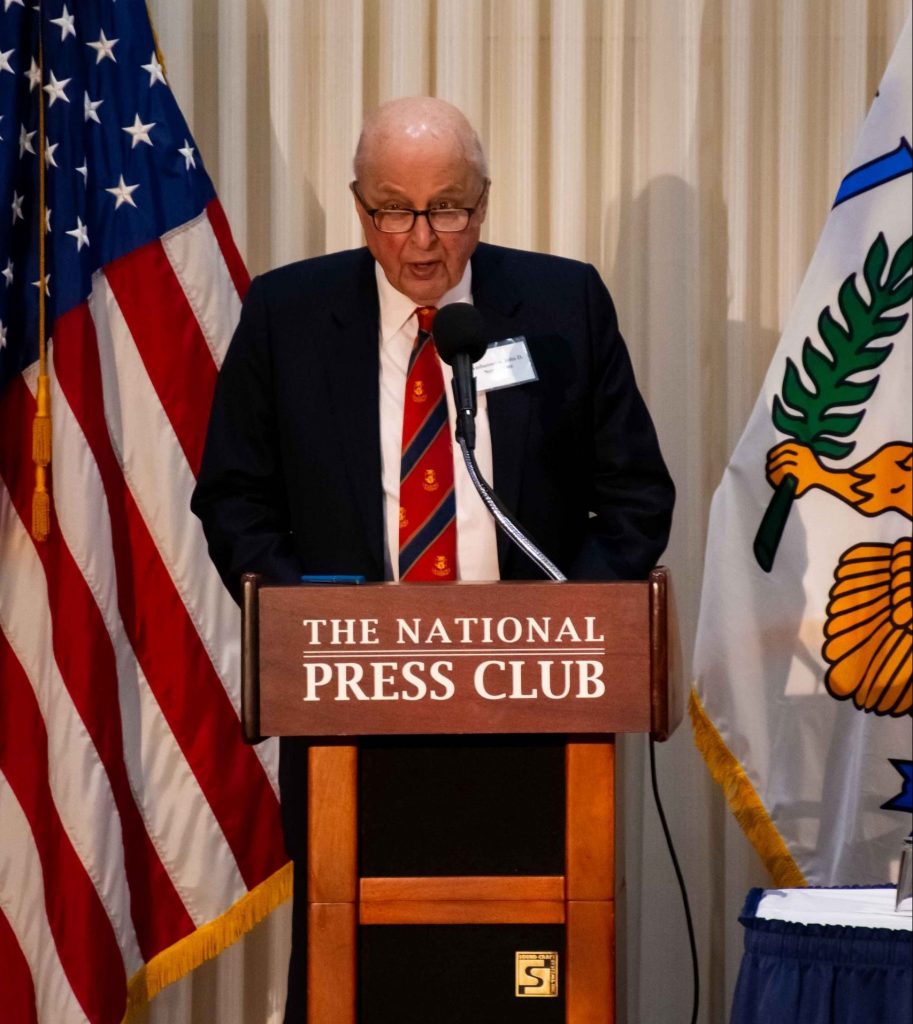
Ambassador John D. Negroponte, former Deputy Secretary of State and first US Director of National Intelligence, speaking at the launch and discussion of “A Revitalization Plan for US Maritime Trade, Commerce and Strategic Competition” on February 1, 2022 in Washington, D.C.
Speaking at the event was former Deputy Secretary of State, Ambassador John Negroponte: “As the first Director of National Intelligence, you can therefore imagine that national security and U.S. competitiveness are among my greatest concerns. For many years, we have been asking ourselves how to boost U.S. maritime competitiveness. As someone who grew up in a family with ties to the United States shipping industry, I’m keenly aware of how strong the U.S. maritime industry was after World War II and how it has dramatically declined since. This past year, the public was made witness to our maritime shortcomings.”
Ambassador Negroponte continued: “The oceans have afforded our nation a considerable part of our prosperity, not to mention our security. With the United States being the largest trading nation in the world, and 90% of goods moving across oceans, it should therefore come as a surprise to many that the United States represents just .4% of the global commercial fleet– less than half of 1%. This lack of
Ambassador John D. Negroponte, former Deputy Secretary of State and first US Director of National Intelligence, speaking at the launch and discussion of “A Revitalization Plan for US Maritime Trade, Commerce and Strategic Competition” on February 1, 2022 in Washington, D.C.
United States ownership of shipping tonnage not only leads to a loss of economic opportunity, but lessens our ability to protect ourselves, and exercise oversight and control of activities occurring on the high seas. I commend this plan and this effort to shed light on this situation as a way to help the United States chart a way forward.”
America’s vulnerability was a key theme at the event: “It is time for all of us to give back and ensure that others have access to the same opportunities that we had. Those opportunities simply do not exist today as they did just decades ago. It saddens me to say that today, America is no longer a significant maritime nation. Under our direct influence, our nation lacks a resilient, secure and technologically enabled maritime supply chain, which leaves us susceptible to extreme market volatility and competitive disruption through normalized distribution channels. We have little to no control over complex systems that disincentivize ownership of vessels operating under the current U.S. flag. To think our highly experienced and accomplished Navy is number one in the world, and yet our commercial maritime merchant fleet is just 21st in the world. The statistics are bleak,” said President Eric R. Dawicki of the Northeast Maritime Institute. “We have lost the ability to independently control our nation’s economic destiny through strategic competition. Without an active plan, we have lost our ability to directly influence the actions of those that trade internationally, across the oceans, and here within our own ports. This is a jarring and stark realization. Additionally, we are in a period of intense upheaval, and change. While the world has been dramatically affected by a disruptive global pandemic and faces ongoing impact of rapidly changing climate and natural disasters, we must also navigate through a diverse array of uncertainties that fuel social unrest, aggressive behaviors by foreign powers that are threatening peace at home, in Europe and in the Far East. And while we navigate through this change and adapt to the ambiguity, we must harken back to this one simple premise, that every great nation was built upon its maritime trade and commerce– and we have watched ours slowly diminish over the last 75 years. In doing so, we have lost a fundamental quality that has been the north star of this great nation ever since it was founded; we have lost our ability to lead by the best of example, in the very industry that built this nation. We must lead with vision; we must lead with purpose. The time is now for the United States to demonstrate creative values-driven and effective leadership in the global maritime community that is propelled by principles and ethical engagement. We must lead with drive to incentivize those who want to operate their ships and move their cargo through an honest and transparent system where everybody wins, and, most importantly, the citizens of the United States win.”
One of the core elements of the plan that was presented included the formation of the U.S. Virgin Islands’ open international ship registry—the first, and only, international U.S. open registry. In endorsing the Revitalization Plan, USVI Governor Albert Bryan Jr. stated “as an American citizen, I look at the numbers, and they make me nervous about our participation in the world trade market and our ability to move goods in good times or in bad as American people. The Virgin Islands is stepping up and we’re saying we support this effort to give America back a bigger piece of this market.”
A similar view was shared by Rear Admiral James Watson (USCG ret.), who said: “I have had wonderful experiences with the U.S. fleet, which is predominantly in a cabotage trade along our coasts and up our rivers and lakes. I know that the international shipping industry is critical to our national security. It concerns me that about 50 percent of the world’s ships are in three open registries. What if some adversaries were to have influence on just one of those and use that to their advantage and to our national disadvantage? I just think you need some counter effort of some kind. This strategy actually puts some really good ideas on the table. I think you need a national flag involved in that international global trade that goes on and to have that sort of confidence for our own well-being that some adversary just won’t sweep all the other flags up and say, ‘U.S. you’re too late to the to the table to get what you need for your national strategy’. We need to act now, and I think we need to have a plan, and this is the only plan right now.”
Security specialist, Northeastern University Professor Stephen Flynn, former President of the Center for National Policy, and senior fellow for National Security Studies at the Council on Foreign Relations, observed: “There is no other critical infrastructure that the United States is as dependent upon, for which it has so little ownership, than the global maritime transportation industry. If you think about any of the other sectors —aviation, telecom, insurance, finance–you have major corporations who are driving those industries who are innovating those industries, and to whom the US government can turn from time to time to say, ‘How do we partner?’ to deal with some of the challenges that those industries and the nation faces. In the case of the United States, though, when it comes to the maritime transportation logistics sector, there really isn’t that opportunity and it has incapacitated, to a large extent, the US government’s ability to work with international private partners on security matters. Our national security protocols simply get in the way of forging deep collaboration and coordination to strengthen the security of the maritime sector.”
Summarized President Dawicki: “The United States is at its most vulnerable point security-wise since I can remember, with the instrument of economic development the best possible facet of security that we could implement. We only have to scratch the surface of history to bring in the U.S. Virgin Islands and the fact that they played such an important role in 1917 protecting us against the Germans, but more importantly they provided such an important role to the psyche and intellectual capacity of Alexander Hamilton who created the United States Coast Guard. We are referring back to that history to create an economic development platform that will secure the interests of the United States not only at home but abroad. For me, this plan is the one instrument that we have seen in decades that will catapult the United States back into the maritime sector as a global player.”
###
Go to US Maritime Revitalization Plan Launch to view the full event.
About Northeast Maritime Institute
Northeast Maritime Institute (also called NMI) is a private, coeducational, maritime college offering an Associate in Applied Science in Nautical Science degree. Established in 1981, Northeast Maritime Institute is the only private maritime college in the Commonwealth of Massachusetts. The college was originally established to provide an alternative to traditional education and training, with an emphasis on preparing mariners for employment. Graduates receive an Associate degree and are eligible to receive a United States Coast Guard Masters license upon graduation. Northeast Maritime Institute has trained over 70,000 mariners since 1995.
About COPE
The Center for Ocean Policy and Economics (COPE) is hosted by the Northeast Maritime Institute – College of Maritime Science: Created to tackle some of the ocean’s “wicked problems.” A culmination of years of extensive research and conversations with leading experts in the maritime and ocean related fields, COPE is a facilitator for cogent maritime and ocean policy and economic development project initiatives linking academic, corporate, non-governmental, and governmental partners to create impactful solutions. Additional information can be found at COPE.
US National Security at Risk with Today’s Maritime Configuration Read More »
11 February 2022
FOR IMMEDIATE RELEASE
PLAN FOR RESTORING US MARITIME COMPETITIVE PRESENCE LAUNCHED IN WASHINGTON
National security, rules-based platform, secure jobs for all mariners included
WASHINGTON, DC — A landmark Revitalization Plan for US Maritime Trade, Commerce and Strategic Competition to support and assist in ensuring maritime sovereignty and security, and revitalizing maritime commerce, was launched last week in Washington, DC. Leading with remarks by Ambassador John D. Negroponte, the first U.S. Director of National Intelligence and former Deputy Secretary of State followed by the Governor of the U.S. Virgin Islands, the Honorable Albert Bryan, Jr. and President Eric R. Dawicki of the Northeast Maritime Institute, the event also included a panel of subject matter experts on national security, regulatory enforcement, technology and trade, and mariner welfare. Highlights of the Plan include the formation of the first U.S. open registry, and other maritime initiatives designed to make the United States more competitive, secure and propel it into a stronger leadership position as a maritime nation.
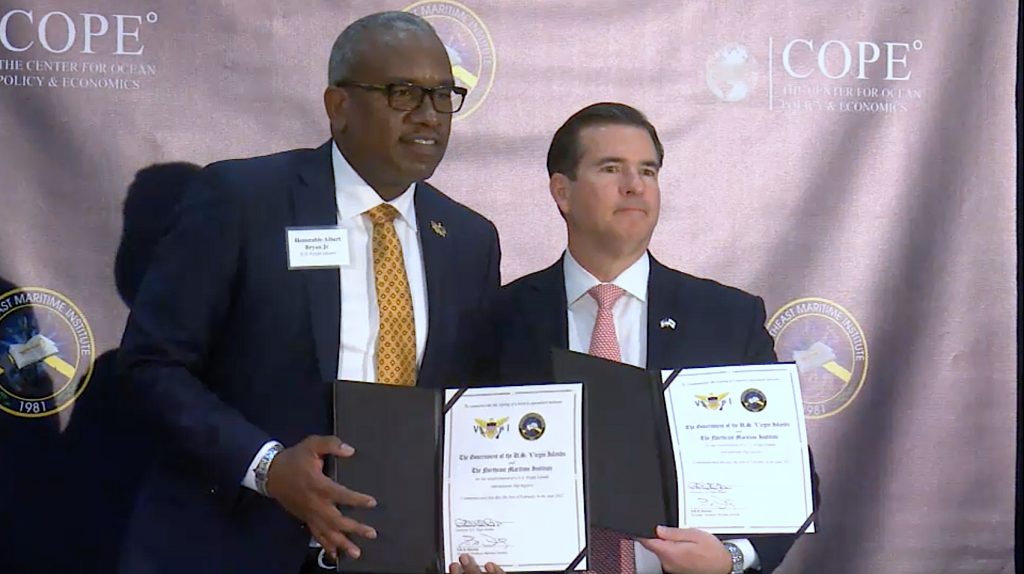
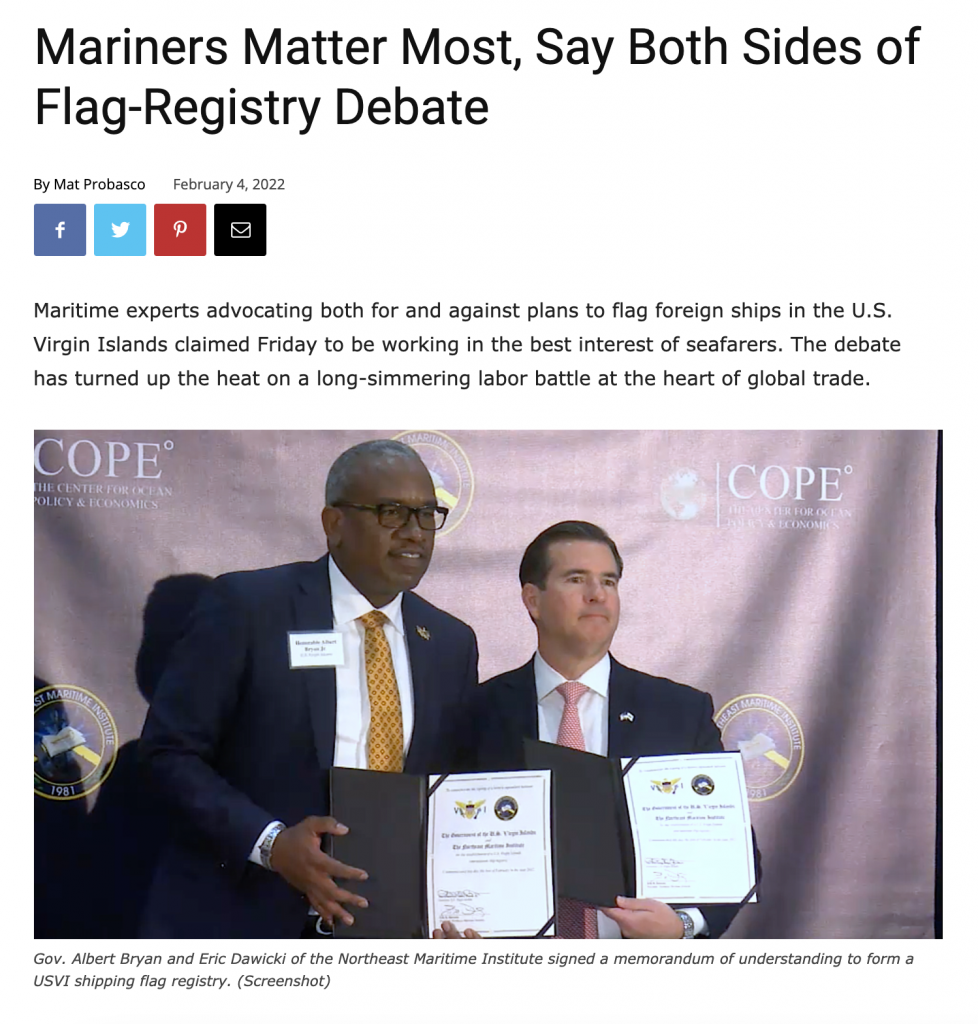
Signifying the importance of the Plan, Governor Bryan and President Dawicki participated in the signing of a historic agreement between the U.S. Virgin Islands and Northeast Maritime Institute which features their collaboration on the development of the first open U.S. registry. The significance of the U.S. Virgin Island’s partnership was made known in the retelling of its acquisition from Denmark by the United States in 1917 to help defend the Panama Canal from German U-boats in the region.
“We gather here today as an interested maritime community, as American citizens and as a collective body of people who care deeply about the maritime industry. We are guided by the creed ‘to honor the Mariner’ and to get back to an industry that has provided wealth and prosperity to our nation throughout the centuries,” stated President Dawicki in his opening remarks. “The revitalization plan for US maritime trade and commerce and strategic competition is ultimately about providing the United States with the tools to build, promote, and maintain a rules-based order on the high seas, and to reemerge as a competitive maritime nation. The plan recognizes that maritime commerce can lead the way towards economic success, peaceful and meaningful trade and commercial opportunities that are driven through strong and verifiable commitments towards environmental, social and governance standards. This project isn’t going to be easy, we will need to come together as one community, one nation, if you will, as common citizens, as mariners, as shippers, as investors and bankers, as trade partners, as manufacturers and retailers alike, and most importantly, through the full support and participation of a harmonized government establishment.”
Captain Anuj Chopra, Co-Founder of ESGPlus, who participated on the panel discussion, commented: “I think this is an opportunity and a day we’re going to remember for many years to come. We’ve had policies which were made decades ago, which served us well in the past as a nation. We now need to rewrite that policy so it will serve us in the 21st and 22nd century, whether it is welfare for seafarers, movement of cargo, security of delivery, or understanding ESG and how it applies to the maritime supply chain or maritime networks.”
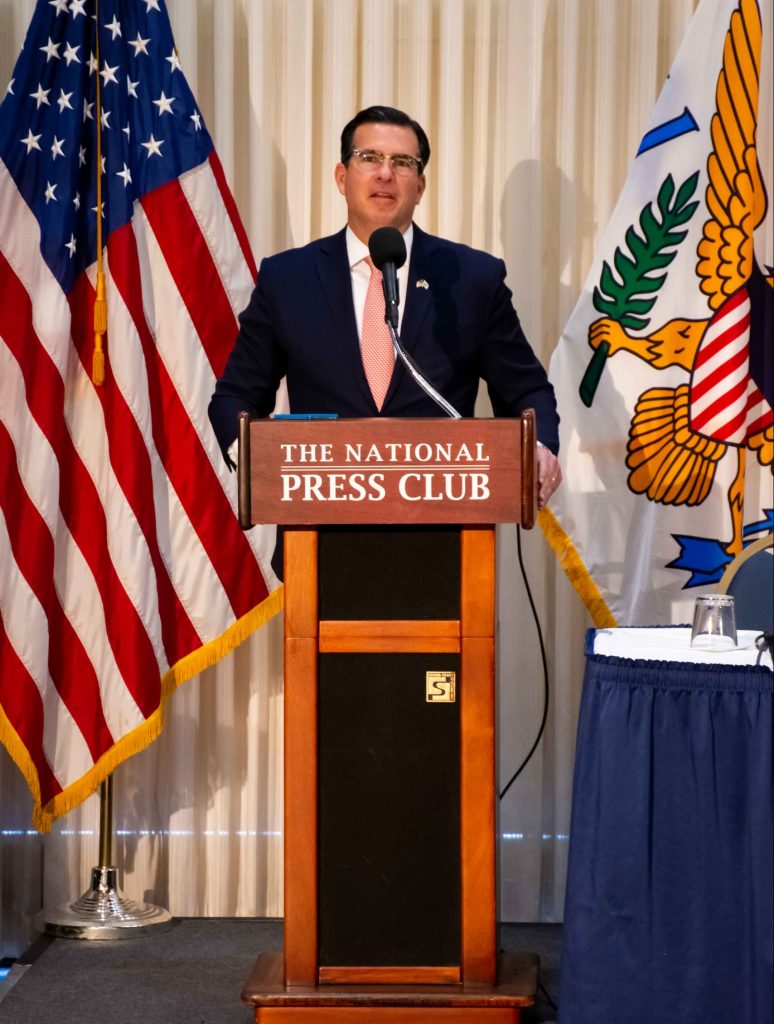
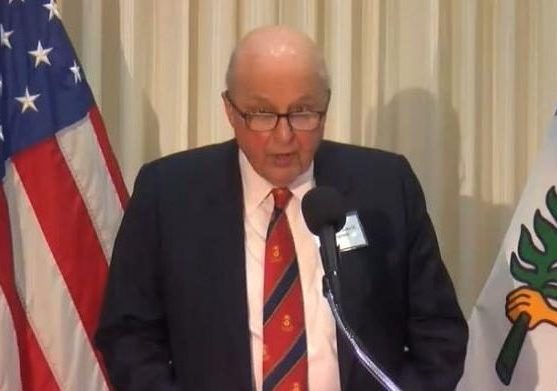
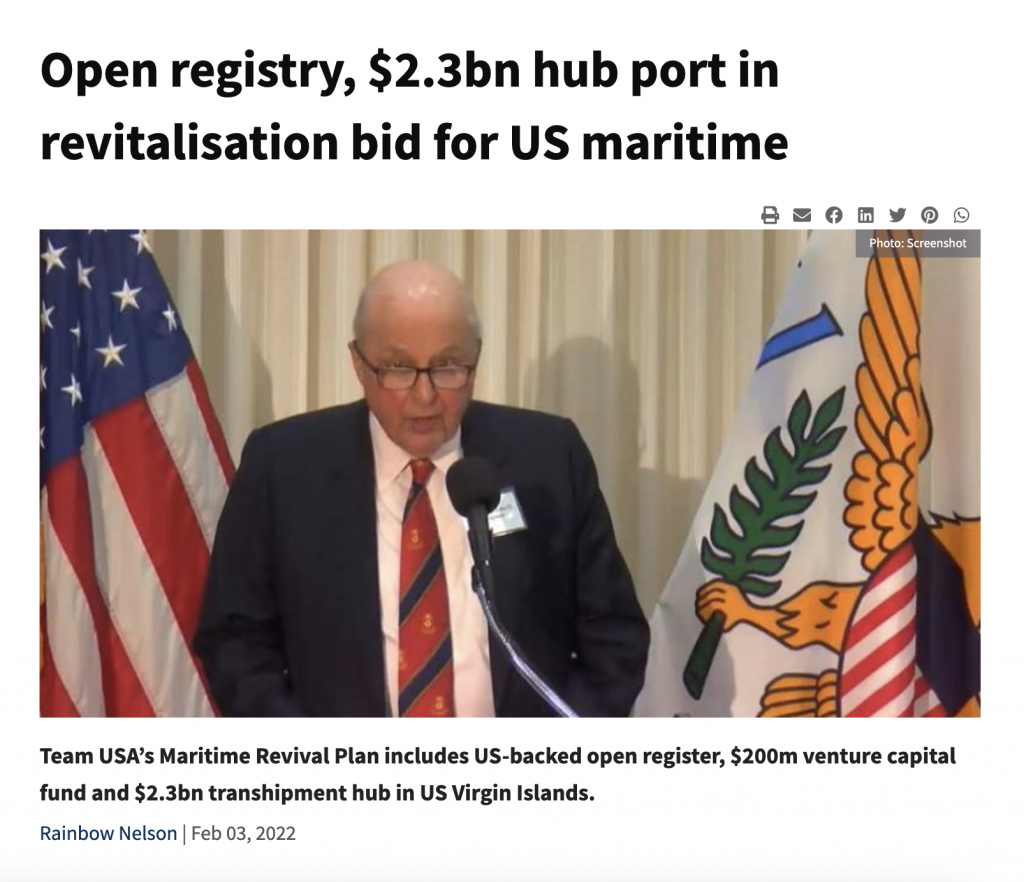
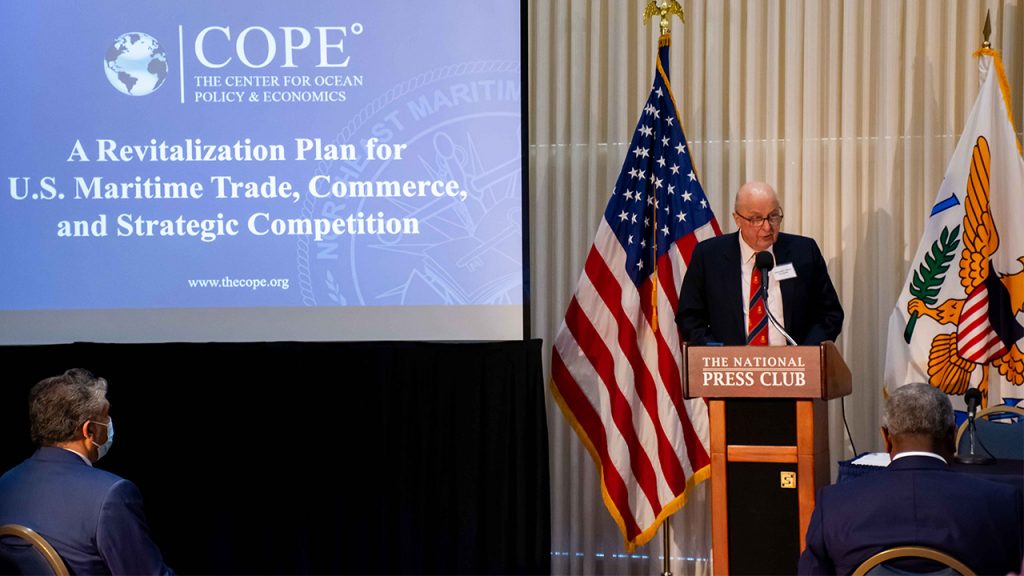
Eric Dawicki, President and CEO of Northeast Maritime Institute, speaking at the launch and discussion of “A Revitalization Plan for US Maritime Trade, Commerce and Strategic Competition” on February 1, 2022 in Washington, D.C.
“We gather here today as an interested maritime community, as American citizens and as a collective body of people who care deeply about the maritime industry. We are guided by the creed ‘to honor the Mariner’ and to get back to an industry that has provided wealth and prosperity to our nation throughout the centuries,” stated President Dawicki in his opening remarks. “The revitalization plan for US maritime trade and commerce and strategic competition is ultimately about providing the United States with the tools to build, promote, and maintain a rules-based order on the high seas, and to reemerge as a competitive maritime nation. The plan recognizes that maritime commerce can lead the way towards economic success, peaceful and meaningful trade and commercial opportunities that are driven through strong and verifiable commitments towards environmental, social and governance standards. This project isn’t going to be easy, we will need to come together as one community, one nation, if you will, as common citizens, as mariners, as shippers, as investors and bankers, as trade partners, as manufacturers and retailers alike, and most importantly, through the full support and participation of a harmonized government establishment.”
Eric Dawicki, President and CEO of Northeast Maritime Institute, speaking at the launch and discussion of “A Revitalization Plan for US Maritime Trade, Commerce and Strategic Competition” on February 1, 2022 in Washington, D.C.
Captain Anuj Chopra, Co-Founder of ESGPlus, who participated on the panel discussion, commented: “I think this is an opportunity and a day we’re going to remember for many years to come. We’ve had policies which were made decades ago, which served us well in the past as a nation. We now need to rewrite that policy so it will serve us in the 21st and 22nd century, whether it is welfare for seafarers, movement of cargo, security of delivery, or understanding ESG and how it applies to the maritime supply chain or maritime networks.”
A Revitalization Plan for US Maritime Trade, Commerce and Strategic Competition was developed by a team of Distinguished Fellows at the Northeast Maritime Institute – Center for Ocean Policy and Economics (COPE) and advised by an array of leading thinkers in the maritime industry. Key elements of the plan include:
“One of the key advantages to the Revitalization Plan is transparency” observed Carleen Lyden Walker, Chief Evolution Officer of SHIPPINGInsight and an event panelist. “The public is coming closer and closer to our industry, and we must be transparent in the way we operate and account for ourselves. Gone are the days when we could sail over the horizon with impunity. Today, we need to be accountable for our waste streams, our treatment of our Mariners and the construct of our companies.”
“The time is now for a rational, pragmatic and highly strategic plan,” concluded President Dawicki. “At this critical juncture in the history of the United States, we have to put this Revitalization Plan into play.”
###
Go to US Maritime Revitalization Plan Launch to view the full event.
About Northeast Maritime Institute
Northeast Maritime Institute (also called NMI) is a private, coeducational, maritime college offering an Associate in Applied Science in Nautical Science degree. Established in 1981, Northeast Maritime Institute is the only private maritime college in the Commonwealth of Massachusetts. The college was originally established to provide an alternative to traditional education and training, with an emphasis on preparing mariners for employment. Graduates receive an Associate degree and are eligible to receive a United States Coast Guard Masters license upon graduation. Northeast Maritime Institute has trained over 70,000 mariners since 1995.
About COPE
The Center for Ocean Policy and Economics (COPE) is hosted by the Northeast Maritime Institute – College of Maritime Science: Created to tackle some of the ocean’s “wicked problems.” A culmination of years of extensive research and conversations with leading experts in the maritime and ocean related fields, COPE is a facilitator for cogent maritime and ocean policy and economic development project initiatives linking academic, corporate, non-governmental, and governmental partners to create impactful solutions. Additional information can be found at COPE.
Plan for Restoring US Maritime Competitive Presence Launched-in-Washington Read More »
People working within the maritime sector should be able to work safe and healthy, regardless of gender, age, cultural background or other differences. A psychological safe and inclusive maritime workplace culture for all seafarers and maritime professionals has a positive effect on operational safety and security on board. It is also essential to the successful integration of vulnerable and marginalized groups in support of diversity, equality, equity and inclusion.
As education and training are critical elements of a holistic framework of change.
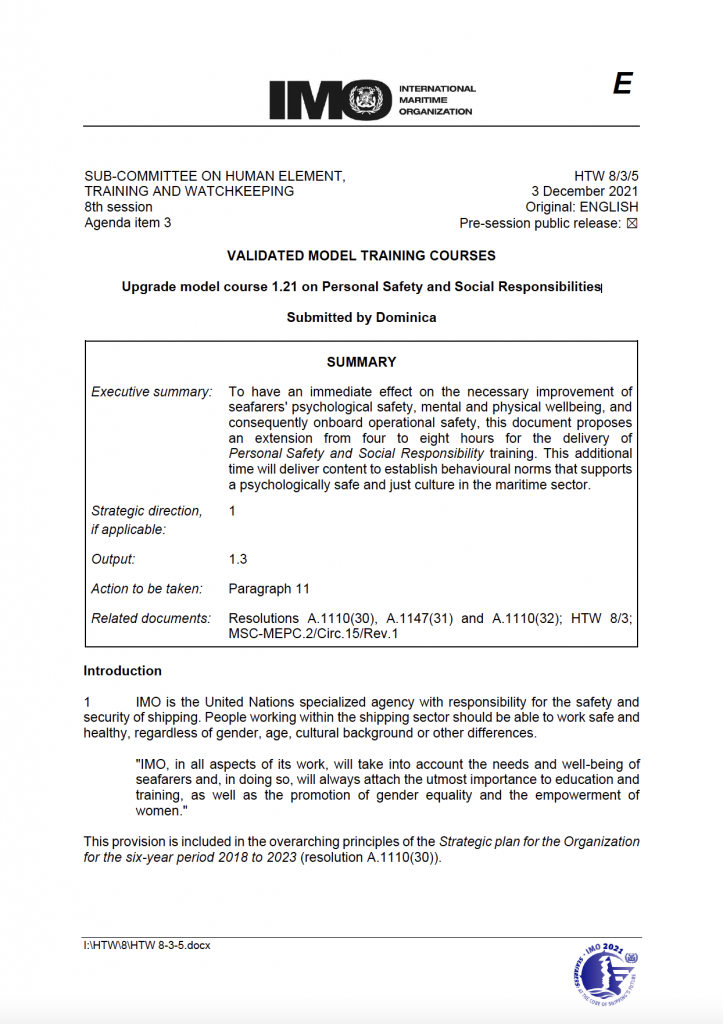
The Commonwealth of Dominica Maritime Registry submitted a paper to the eight session of IMO’s Sub-Committee of Human element, Training and Watchkeeping with a proposal to extend the delivery of the Personal Safety and Social Responsibility (PSSR) training from four to eight hours. The additional time will deliver content to establish behavioural norms that supports a psychologically safe and just culture in the maritime sector.
Please access the document below:
Upgrade model course 1.21 on Personal Safety and Social Responsibilities Read More »