Events

31 May Meeting – COPE° Working group on Psychological Safety and Sexual Assault and Harassment in the Maritime Sector

Meeting Minutes: COPE° Working group on Psychological Safety and Sexual Assault and Harassment in the Maritime Sector

TUES, MAY 31, 2022 | 6:00 AM EST

1) Welcome and Introduction

The group would like to hear more about this initiative.

2) Activities and Scope of Work

a) Sub-Group on Review and amend existing IMO Model Course 1.21 PSSR

  • Next meeting of the sub-group is planned on 8 June at 11.00 UTC
  • Jillian will host this meeting of the sub-group
  • Eva will send the latest, cleaned up version of our work to the group when Jillian has finished her notes and comments in the document.
  • The final review of the PSSR Model Course needs to be finished before November 2022, since the deadline for submission for HTW is in Feb 2023, and MSC107 will be in May 2023.
  • The group will receive a template with notes and advice on the content of the document: 1) background on the process to develop the changes to the Convention and the model course (i.e. experts, etc.); 2) amendments to the Convention KUPs; 3) changes to the model course. Concentrate on the development of the IMO submission. In her opinion, the document will get support.
  • Advice and input were given on the submission to IMO on PSSR:
    • Pull the Knowledge Understanding and Proficiencies (KUP’s) from the already developed changes to the model course.
    • Focus also on STCW Chapter I Regulation 14 for Companies (Guidance regarding responsibilities of companies and recommended responsibilities of masters and crew). This regulation will provide a link to the ISM Code.

b) Evaluate and provide training options

  • The group agreed to first work on the IMO Model Course on PSSR, and remain open to suggestions, collaborations and/or further work.
  • Designing courses on NEMO°, available totally free of charge. Investigating other training options. Taking into account. Minimum standards and Advanced standards. Listing out different kinds of outputs for parties to consider and opportunities for user groups.

c) Harmonizing best practices and guidance documents, industry resources and studies

  • The group decided to start a sub-group on ‘Data Collection, Output and Harmonization.’ Individuals have already taken initiative and started describing the scope of work for this sub-group.
  • Information on activities of the joint ILO/IMO working group. The hope is that the group is able to start working together near the end of this year.
  • Trafficking at sea. As discussed during our previous meeting, Debbie thinks that even though trafficking is a very important topic, it lies outside of the scope of the current initiative. The group decided to keep this topic on the agenda and invites members to share ideas about a way forward.

d) Awareness and response

Output relevant for mariners and other maritime professionals will be shared online by means on different channels. The working group will be open to hear the voice of the industry and take information into consideration.

  • Ideas for live YouTube sessions and/or podcast episodes:
    • Create the next live session with seafarers.
    • Share ‘nuggets’ on specific actionable items that people can do today
    • Attend external podcasts
    • Create a guide for resources for the Environmental and Social Governance (ESG) for companies applicable for shipping
    • Voices all around should be heard, all across the industry.
  • Create a video about our group in order to highlight our areas of expertise: what does is mean to be an ‘Agent of change’
  • Write a ‘position paper’, that we can publish to several maritime outlets as well as scientific journals to inform what we are doing and to create awareness – facilitating change.
  • Highlight best practices and positive actions (it is not all about doom and gloom)
  • Content should obtain: Validation, Game-plan, Push for change.

Other ideas:

  • Create a resources page on the COPE° website, so information will be available more conveniently and more transparent.
  • Create a guide for resources for the Environmental and Social Governance (ESG) for companies applicable for shipping. (Eva will put this on the scope of work for the sub-group on ‘Data Collection, Output and Harmonization’)

e) Reporting mechanisms and accountability

  • The group discussed how to link language about psychological safety, DEIA and SASH that is used in the IMO model course 1.21 on PSSR to the ISM Code and ISPS Code. Concerns were raised that ISPS may not be the right instrument to address this issue since it deals with security issues only and not personnel or human resource issues. However; there may be issues in the periphery that need to be address.
  • We can gather information that is done from our work on the PSSR Model Course, and use it for our future work to implement language on the ISM code and ISPS code.
  • The proposal to start a sub-group on ‘ISM and ISPS Code’ is postponed for now. We should first focus on the Model Course and way forward within IMO. Eva will make sure language and information about this is saved in the COPE° Teams Group.
  • Investigate more about SASH reporting mechanism, accountability, processes, responsibilities, and guidance’s.
  • Include information about port-based welfare committees, IHMA forum, ICMA or other organizations and might have information.

3) Information on activities of the joint ILO/IMO working group

The hope is that the group is able to start working together withITF, ICS, IMO and ILO near the end of this year.

4) Decisions and Take-Aways

  • Continue the review of PSSR Model Course 1.21 on 8 June at 11.00 UTC.
  • Sub-groups coalition is created to work on ‘Data Collection, Output and Harmonization’.
  • Focus on creating content, video and consider writing a paper on our work and our ‘Agents for change’.
  • Upload spreadsheet in COPE° Teams Group with ‘links and blurbs’.
  • Create a resources page on the COPE° website.

5) Next Meeting

Proposed to meet on Tuesday 14 June – 11.00 UTC

Proposed future meeting days:

  • Tuesday 05 July 2022
  • Tuesday 29 July 2022

ANNEX A
List of Members and Participants

The members and participates of the COPE° Working group on Psychological Safety and Sexual Assault and Harassment in the Maritime Sector are listed below.

*The information in the list is privacy sensitive, and thus will not be published here.*

ANNEX B
Terms of Reference

The COPE° Working group on Psychological Safety and Sexual Assault and Harassment in the Maritime Sector is hosted by Center for Ocean Policy and Economics, a subset of The Northeast Maritime Institute – College of Maritime Science. COPE° facilitates committed maritime government, non-government, corporate, education, science and technology experts and partners to collaborate and create drivers for change. Members of the working group will be sharing information, ideas, learnings and pooling resources in order to work on:

  1. developing and delivering relevant actions and impactful solutions
  2. drivers for change, in order to tackle the wicked problems present in our world today
  3. solutions to build on an international UN framework to connect the industry to objectives.

The work the COPE° working group will be driven by ethical and humanitarian based values, taking into account:

  1. building on a psychologically safe workplace culture in the maritime sector
  2. the successful integration of vulnerable and marginalized groups, in support of diversity, equality, equity, inclusion and acceptance
  3. the issues relating to sexual assault, harassment and bullying in the maritime sector
  4. transparency and integrity
  5. supporting and honoring mariners globally
3 May Meeting – COPE° Working group on Psychological Safety and Sexual Assault and Harassment in the Maritime Sector

Meeting Minutes: COPE° Working group on Psychological Safety and Sexual Assault and Harassment in the Maritime Sector

TUES, MAY 3, 2022 | 6:00 AM EST

1) Welcome and Introduction

Activities since last meeting:

  • The group discussed the very positive outcome from MSC105. Great gratitude and thankfulness was expressed to all participants of this group. It is truly unique that the IMO Model Course on PSSR is taken forward with priority, and is developed and amended in such a short timeframe.
  • The group discussed how we can mitigate possible roadblocks and advocacy against the work we are doing:
    • Some negative remarks were made during the IMO plenary discussions regarding policy and procedure. Delegations of Saudi Arabia, Dominica and others intervened during plenary and stated that policy and procedure must serve the people. We have to support people, and it is important to do this work now.
    • A remark was made that sometimes these types of topics are ‘hijacked’ by companies or organizations for political aim or marketing reasons.
    • The Terms of Reference of our group clearly states that the COPE° working group will be driven by ethical and humanitarian based values. Informing skeptics, being transparent about our intentions and continuing our efforts with an open mind will hopefully help getting people on board and collaborate on the main goals we wish to achieve to improve the situation.
  • The group quickly reflected on two YouTube live sessions last week.

Several organizations and IMO Member States showed interest in our group and requested to join:

  • ITF requested to join, the group agreed.
  • UAE, Egypt and Panama requested information following the MSC meeting last week. We are happy to inform anyone who is interested about our work. Meeting notes, terms of reference and other information is available on the website or COPE° and people are very welcomed to share.

The Bahamas delegation informed the group about the upcoming ILO meeting on revision of the MLC2006. He will update the group on what was discussed in this ILO meeting on our next session.

2) Activities and Scope of Work

a) Sub-Group on Review and amend existing IMO Model Course 1.21 PSSR

Together with documents from other delegations, document MSC105/16/4, submitted to IMO Maritime Safety Committee by Dominica, Turkey, Saudi Arabia, InterManager, IIMA, ICHCA International, IFSMA, AMPP was discussed by MSC105 on 26 April 2022.

From the draft Report of MSC105 – WP.1:

  • 16.18 Taking into account the actions already taken in relation to the JTWG to identify and address seafarers’ issues and the human element (see paragraph 16.14), the Committee:
    • .1 confirmed that the JTWG should consider the development of training provisions addressing bullying and harassment in the maritime sector, including sexual assault and sexual harassment, within its new term of reference (see paragraph 16.14.1); and
    • .2 instructed the HTW Sub-Committee to develop and finalize, as a matter of priority, STCW training provisions addressing bullying and harassment in the maritime sector, including sexual assault and sexual harassment, as part of the new output on “Comprehensive review of the 1978 STCW Convention and Code” approved at this session (see paragraph […]), taking into account the work to be done in coordination with the JTWG. (JTWG = Tripartite joint ILO/IMO working group)

The draft of the meeting report from MSC105 and the intervention that Dominica made during the plenary session will be shared with the working group for reference and information.

Jillian Carson-Jackson will provide an update on when the working group will proceed. Next meetings are scheduled on:

  • Wednesday 11 May in the morning
  • Thursday 19 May in the evening

b) Evaluate and provide training options

Designing courses on NEMO, available totally free of charge. Investigating other training options. Taking into account. Minimum standards and Advanced standards. Listing out different kinds of outputs for parties to consider and opportunities for user groups.

The way forward regarding this topic was discussed with the group:

  • We could use existing training options, like ISCA Wellbeing, who just published trail courses which are endorsed by Bahamas,
  • ISWAN has training available as well, and raises awareness on the importance of not only having this available online but also in physical form.
  • We should try to ‘Funnel down’ the actual problem in the education, let people talk about this as part of the training. Include personal stories and create a ‘360 view’.
  • People from different companies, backgrounds, etc should be involved to get different perspectives etc. Only one company with input is a risk.
  • We need all the different aspects of mental health, you can’t fully understand that using online training only. We need to understand each other and respect each other.

Conclusion: We will first start with amending the IMO Model Course on PSSR and will remain open to all groups/companies who already provide this kind of curriculum and training and/or wish to develop it together with us.

c) Harmonizing best practices and guidance documents, industry resources and studies

Amongst United Nations bodies (IMO and ILO); NGO diversity manuals such as ICS, WISTA, ISWAN, BIMCO, INTERTANKO, INTERCARGO and the World Shipping Council. How do we make sure this work is easily implemented into ISM manuals, company procedures, etc.

  • Information about guidance and training from ISWAN is shared as an attachment to the meeting minutes in e-mail. ISWAN is invited to share more information on the next meeting of the working group.
  • Activities of the joint ILO/IMO working group will be monitored.

d) Awareness and response

Output relevant for mariners and other maritime professionals will be shared online by means on different channels. The working group will be open to hear the voice of the industry and take information into consideration. Reliable and accurate information about different aspects.

  • We will plan another live YouTube session on 18 May, which is ‘International Day for Women in Maritime.’
  • Other ideas or contributions are very much welcomed.

e) Reporting mechanisms and accountability

  • Investigate more about SASH reporting mechanism, accountability, processes, responsibilities and guidance’s.
  • Invite people to think about how we can link language on IMO model course 1.21 to the ISM Code.

3) Decisions and Take-Aways

  • Bahamas delegation will inform the group about the ILO meeting on revision of the MLC2006.
  • The draft of the meeting report from MSC105 (MSC015 WP.1) and the intervention that Dominica made during the plenary session will be shared with the working group for reference and information
  • ISWAN is invited to share more information about guidance, material, training, etc.
  • We will plan a Live session on YouTube on 18 May, on the work of this group.

4) Next Meeting

The sub-group working on the IMO Model Course is going to meet on 11 May 2022 and 19 May 2022, Ms. Jillian Carson Jackson is going to update the group on the exact times and meeting links.

Proposed to meet on Tuesday 17 May 2022 at 11.00 UTC using the Zoom platform.
Proposed future meeting days:

  • Tuesday 31 May 2022
  • Tuesday 14 June 2022
  • Tuesday 05 July 2022
  • Tuesday 29 July 2022

ANNEX A
List of Members and Participants

The members and participates of the COPE° Working group on Psychological Safety and Sexual Assault and Harassment in the Maritime Sector are listed below.

*The information in the list is privacy sensitive, and thus will not be published here.*

ANNEX B
Terms of Reference

The COPE° Working group on Psychological Safety and Sexual Assault and Harassment in the Maritime Sector is hosted by Center for Ocean Policy and Economics, a subset of The Northeast Maritime Institute – College of Maritime Science. COPE° facilitates committed maritime government, non-government, corporate, education, science and technology experts and partners to collaborate and create drivers for change. Members of the working group will be sharing information, ideas, learnings and pooling resources in order to work on:

  1. developing and delivering relevant actions and impactful solutions
  2. drivers for change, in order to tackle the wicked problems present in our world today
  3. solutions to build on an international UN framework to connect the industry to objectives.

The work the COPE° working group will be driven by ethical and humanitarian based values, taking into account:

  1. building on a psychologically safe workplace culture in the maritime sector
  2. the successful integration of vulnerable and marginalized groups, in support of diversity, equality, equity, inclusion and acceptance
  3. the issues relating to sexual assault, harassment and bullying in the maritime sector
  4. transparency and integrity
  5. supporting and honoring mariners globally
12 April Meeting – COPE° Working group on Psychological Safety and Sexual Assault and Harassment in the Maritime Sector

Meeting Minutes: COPE° Working group on Psychological Safety and Sexual Assault and Harassment in the Maritime Sector

TUES, APRIL 12, 2022 | 7:00 AM ET

1) Welcome

Participants of the meeting were invited to introduce themselves if they wish to in order to get to know each other a little better.

New members proposals were introduced with the group and agreed upon.

2) Activities and Scope of Work

For reference, find scope of work of this COPE° working group:

  1. Review and amend existing IMO model course 1.21 – Personal Safety and Social Responsibility
    As proposed in document MSC105/16/4, submitted to IMO Maritime Safety Committee in 2022 by Dominica, Turkey, Saudi Arabia, InterManager, IIMA, ICHCA International, IFSMA, AMPP.
  2. Evaluate and provide training options
    Designing courses on NEMO, available totally free of charge. Investigating other training options. Taking into account. Minimum standards and Advanced standards. Listing out different kinds of outputs for parties to consider and opportunities for user groups.
  3. Harmonizing best practices and guidance documents, industry resources and studies
    Amongst United Nations bodies (IMO and ILO); NGO diversity manuals such as ICS, WISTA, ISWAN, BIMCO, INTERTANKO, INTERCARGO and the World Shipping Council. How do we make sure this work is easily implemented into ISM manuals, company procedures, etc.
  4. Awareness and response
    Output relevant for mariners and other maritime professionals will be shared online by means on different channels. The working group will be open to hear the voice of the industry and take information into consideration. Reliable and accurate information about different aspects.

a) Sub-Group on IMO Model Course 1.21 PSSR

Latest version of the review of IMO Model Course 1.21 on PSSR was by email on Monday. We thank everyone who worked on reviewing this course already with the great work done so far. And invite interested people to join the sub-group working on the IMO Model Course.

Jillian Carson-Jackson provided an update on the work on the PSSR Model Course. Discussion points were:

  • Link with ISM – Language input on ISM on psychological safety on emergency situations, arising from this Model Course
  • During the IMO review of the Model Courses, the timetable will probably be removed for all of the Model Courses, into a recommended range of durations. This was mentioned during the HTW8 IMO sub-committee.
  • This COPE° working group will focus on the content more than on the hours, we want to mention that at IMO as well.
  • We invite people joining this meeting to describe what this work means to them, which we can use for awareness of this group and light up the focus on the work we do. We could use this while doing a YouTube live webinar or by having language about it on the NEMO° course we will develop later.
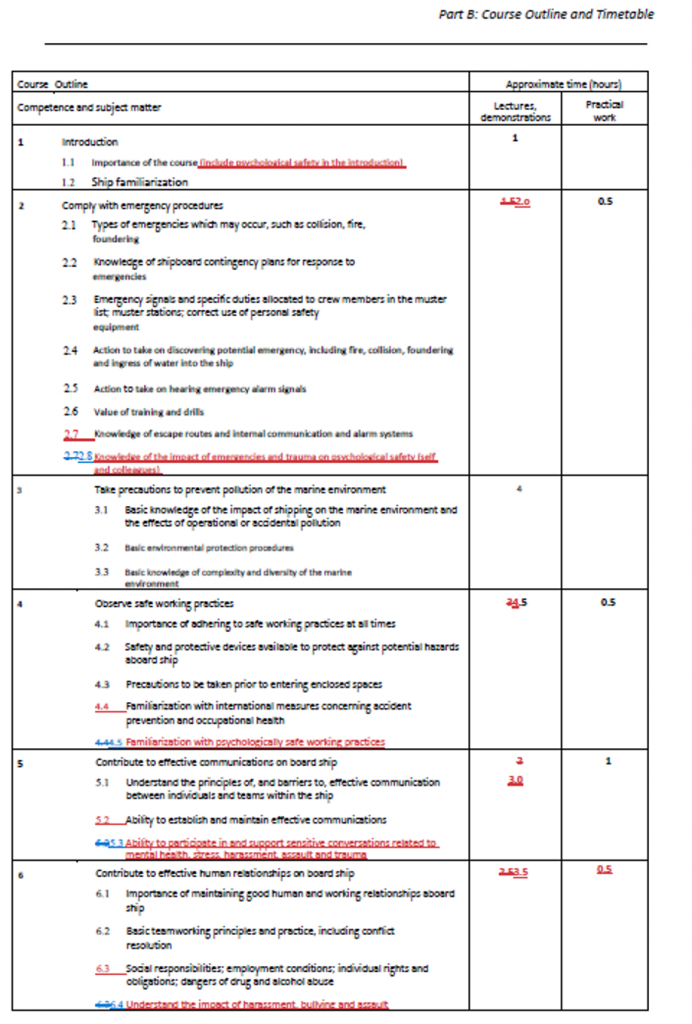
  • The table of part B – Par 6.4 mentions “Understand the impact of harassment, bullying and assault on ship safety, victims, and bystanders”. It is expected that the MSC is going to argue if this language should stay in the IMO model course. The group agreed that a Model Course is meant to be a guidance document and that this language is of utmost importance to keep.
  • If IMO Maritime Safety Committee agrees to do the review, then Dominica will be willing to take this forward in a working group within IMO.
  • Eva will send all participants copies of the documents to MSC105 submitted for Human element training and watchkeeping, by other IMO Member States.
  • The meetings of the sub-group to work on the IMO Model Courses are usually divided into two meetings to cover the different time zones. We will plan another meeting of the sub-group on our next session at 3 May 2022.

b) Reporting mechanisms and accountability

(postponed this agenda item to the next meeting on 3 May 2022)
Investigate more about SASH reporting mechanism, accountability, processes, responsibilities, and guidance.

  • Are there people who want to join on this work?

3) Decisions and take-aways

  • Invite people joining this meeting to describe what this work means to them.
  • Schedule a YouTube Live Webinar to discuss our work, the purpose and way forward in public. (Eva will share details and invite later this week.)
  • Update the participants of this meeting with documents submitted to MSC105 on human element training and watchkeeping.
  • Invite people to think about how we can link language on IMO model course 1.21 to the ISM.
  • We will wait with working on the IMO Model course 1.21 until after the Maritime Safety Committee will discuss documents on this work on 25 April 2022.

4) Next meeting

Proposed to meet on Tuesday 3rd May 2022 at 11.00 UTC using the Zoom platform.

ANNEX A
List of Members and Participants

The members and participates of the COPE° Working group on Psychological Safety and Sexual Assault and Harassment in the Maritime Sector are listed below.

*The information in the list is privacy sensitive, and thus will not be published here.*

ANNEX B
Terms of Reference

The COPE° Working group on Psychological Safety and Sexual Assault and Harassment in the Maritime Sector is hosted by Center for Ocean Policy and Economics, a subset of The Northeast Maritime Institute – College of Maritime Science. COPE° facilitates committed maritime government, non-government, corporate, education, science and technology experts and partners to collaborate and create drivers for change. Members of the working group will be sharing information, ideas, learnings and pooling resources in order to work on:

  1. developing and delivering relevant actions and impactful solutions
  2. drivers for change, in order to tackle the wicked problems present in our world today
  3. solutions to build on an international UN framework to connect the industry to objectives.

The work the COPE° working group will be driven by ethical and humanitarian based values, taking into account:

  1. building on a psychologically safe workplace culture in the maritime sector
  2. the successful integration of vulnerable and marginalized groups, in support of diversity, equality, equity, inclusion and acceptance
  3. the issues relating to sexual assault, harassment and bullying in the maritime sector
  4. transparency and integrity
  5. supporting and honoring mariners globally
ANNEX C
Activity 1 – Review of IMO Model Course 1.21 – Personal Safety and Social Responsibility

This sub-group will be chaired by Ms Jillian Carson-Jackson. The sub-group will update the main group on their work in the next meeting.

It is proposed that the existing model course is reviewed and amended in a stepwise approach:

  • Step 1 – review and update the existing model course as an incremental revision, based on the proposals identified in Annex I. develop the revised course outline and teaching syllabus for Model Course 1.21
  • Step 2 – review and consider amending the priority level 4 for the model course and, as appropriate, commence the full review as soon as possible taking into account the current workload for model course review and validation.

Noting the mature nature of IMO Model Course 1.21, and the focus on amending to expand existing training on safe working practices, effective communications on board ship, and effective human relationships on board ship to include elements of psychological safety and dealing with trauma and trauma response, it is proposed that Step 1 could be initiated following agreement at MSC 105, with the draft revised model course provided to HTW9 for validation.

The focus of the informal working group will be to provide the revision and provide content to the model course.

Points to consider:

  • Action in case of human emergency/accident is not well covered.
  • Action in case of personal crisis is not covered.
  • Advantages of shipboard community (in time of cabin internet) needs to be expanded.
  • Ethnicity culture & SASH needs to be addressed.
  • Should we be looking at a Basic PSSR and an Advanced PSSR for the Management team?

ANNEX I

29 March Meeting – COPE° Working group on Psychological Safety and Sexual Assault and Harassment in the Maritime Sector

Meeting Minutes: COPE° Working group on Psychological Safety and Sexual Assault and Harassment in the Maritime Sector

TUES, MARCH 15, 2022 | 6:00 AM ET

1) Welcome

There was confusion around what time this meeting was scheduled for. Because of the many different time zones of the participants, this meeting was scheduled at 22.00 CET. A structured approach was proposed to avoid confusion about scheduled meeting times moving forward.

Participants of this meeting introduced themselves to get to know each other a little better.

2) Introduction of the Participants

The “List of participants” provided in Annex A of the meeting minutes from our previous session was presented. No further comments were given. It was decided that new applicants and interested people of this working group are going to be asked to send a short message containing their intentions, visions and introduction of themselves via email. We will then review those applicants’ applications in our next meeting and decide if those applicants are invited to join.

Current members of the group are invited to introduce persons who they think can contribute to the work on the group at any stage.

3) Activities

a) TERMS OF REFERENCE

The terms of reference as mentioned in Annex B: “Terms of reference” of the meeting notes were discussed and agreed upon by the group.

Discussion led to the decision to add the term “Acceptance” to diversity, equality, equity, and inclusion.

It was further noted that using the UN framework in a broader scope than just the IMO is a great idea. In this regard it was mentioned that we invited ILO to join this working group. ILO indicated they were excited about the work this group is doing but are still assessing whether or not to join. We are not sure about the reasons for this and will keep close communication with ILO with regards to the resources and information they are sharing.

The Terms of reference are to be uploaded on the COPE° website for documentation.

b) SCOPE OF WORK

Activities the COPE° working group will be focusing on was discussed in reviewing the Scope of work: 

  • Review and amend existing IMO model course 1.21 – Personal Safety and Social Responsibility
    As proposed in document MSC105/16/4, submitted to IMO Maritime Safety Committee in 2022 by Dominica, Turkey, Saudi Arabia, InterManager, IIMA, ICHCA International, IFSMA, AMPP.

  • Evaluate and provide training options
    Designing courses on NEMO, available free of charge. Investigating other training options, taking into account minimum standards and advanced standards. Listing out different kinds of outputs for parties to consider and opportunities for user groups.

  • Harmonizing best practices and guidance documents, industry resources and studies
    Amongst United Nations bodies (IMO and ILO); NGO diversity manuals such as ICS, WISTA, ISWAN, BIMCO, INTERTANKO, INTERCARGO and the World Shipping Council. How do we make sure this work is easily implemented into ISM manuals, company procedures, etc.?

  • Awareness and response
    Output relevant for mariners and other maritime professionals will be shared online by means on different channels. The working group will be open to hear the voice of the industry and take information into consideration. There will be an emphasis on ensuring that information shared is reliable and accurate.

c) SUB-GROUP ON IMO MODEL COURSE 1.21 PSSR

The first sub-group started to work on the IMO Model Course 1.21 on Personal Safety and Social Responsibility. The work is outlined and described in Annex C: “Activity 1 – Review of IMO Model Course 1.21 – Personal Safety and Social Responsibility.” The group updated the entire working group on the work of this sub-group.

The meeting proposed the sub-group to look into implementing language about the health impact of insufficient daylight and fatigue. Another subject to consider and discuss is the social aspect of sharing time around a meal on board. Not only does the quality of food have an impact on peoples’ health, but also the social interactions had during meals.

The meeting discussed the need for a reporting mechanism about SASH and unacceptable behavior, also questioning whether the group should consider inserting this into the group’s scope of work.

  • Could we investigate what is currently out there with regard to the means of reporting SASH? What are the challenges, what is the role of port states, flag states, companies, organizations and authorities?
  • Accountability guidance of ITF was mentioned, as well as the work of SaferWaves.

Ms. Jillian Carson-Jackson will inform members about the sub-working group’s next meeting in due time.

4) Decisions and Take-Aways

  • Agreed upon and approved the Terms of Reference and scope of work
  • Agreed to introduce new proposed members at next sessions
  • Jillian Carson-Jackson will inform members about the sub-working group’s next meeting, where they will work on the IMO Model Course
  • Add to the agenda of the next meeting: Investigate more about SASH reporting mechanisms, accountability, processes, responsibilities and guidance.

5) Next Meeting

Proposed to meet on Tuesday 12 April 2022.

ANNEX A
List of Members and Participants

The members and participates of the COPE° Working group on Psychological Safety and Sexual Assault and Harassment in the Maritime Sector are listed below.

*The information in the list is privacy sensitive, and thus will not be published here.*

ANNEX B
Terms of Reference

The COPE° Working group on Psychological Safety and Sexual Assault and Harassment in the Maritime Sector is hosted by Center for Ocean Policy and Economics, a subset of The Northeast Maritime Institute – College of Maritime Science. COPE° facilitates committed maritime government, non-government, corporate, education, science and technology experts and partners to collaborate and create drivers for change. Members of the working group will be sharing information, ideas, learnings and pooling resources in order to work on:

  1. developing and delivering relevant actions and impactful solutions
  2. drivers for change, in order to tackle the wicked problems present in our world today
  3. solutions to build on an international UN framework to connect the industry to objectives.

The work the COPE° working group will be driven by ethical and humanitarian based values, taking into account:

  1. building on a psychologically safe workplace culture in the maritime sector
  2. the successful integration of vulnerable and marginalized groups, in support of diversity, equality, equity, inclusion and acceptance
  3. the issues relating to sexual assault, harassment and bullying in the maritime sector
  4. transparency and integrity
  5. supporting and honoring mariners globally

ANNEX C
Activity 1 – Review of IMO Model Course 1.21 – Personal Safety and Social Responsibility

This sub-group will be chaired by Ms Jillian Carson-Jackson. The sub-group will update the main group on their work in the next meeting.

It is proposed that the existing model course is reviewed and amended in a stepwise approach:

  • Step 1 – review and update the existing model course as an incremental revision, based on the proposals identified in Annex I. develop the revised course outline and teaching syllabus for Model Course 1.21
  • Step 2 – review and consider amending the priority level 4 for the model course and, as appropriate, commence the full review as soon as possible taking into account the current workload for model course review and validation.

Noting the mature nature of IMO Model Course 1.21, and the focus on amending to expand existing training on safe working practices, effective communications on board ship, and effective human relationships on board ship to include elements of psychological safety and dealing with trauma and trauma response, it is proposed that Step 1 could be initiated following agreement at MSC 105, with the draft revised model course provided to HTW9 for validation.

The focus of the informal working group will be to provide the revision and provide content to the model course.

Points to consider:

  • Action in case of human emergency/accident is not well covered.
  • Action in case of personal crisis is not covered.
  • Advantages of shipboard community (in time of cabin internet) needs to be expanded.
  • Ethnicity culture & SASH needs to be addressed.
  • Should we be looking at a Basic PSSR and an Advanced PSSR for the Management team?

ANNEX I

15 March Meeting – COPE° Working group on Psychological Safety and Sexual Assault and Harassment in the Maritime Sector

Meeting Minutes: COPE° Working group on Psychological Safety and Sexual Assault and Harassment in the Maritime Sector

TUES, MARCH 15, 2022 | 6:00 AM ET

1) Welcoming Remarks

Ms. Eva Lianne Veldkamp opened the meeting thanking the participants and explaining the working group is hosted by Center for Ocean Policy and Economics – COPE°. The Northeast Maritime Institute – College of Maritime Science, created The Center for Ocean Policy and Economics this year. COPE° facilitates committed maritime government, non-government, corporate, education, science and technology experts and partners to collaborate on developing and delivering relevant actions and impactful solutions.

COPE° was developed to serve as both a driver for change, as well as a vessel for others to share ideas, collaborate, and pool resources to tackle the wicked problems present in our world today.

This working group is going to work on projects to provide solutions to build on an international framework which supports a psychologically safe workplace culture. Psychological safety will have a positive effect on operational safety and security on board ships and is essential to the successful integration of vulnerable and marginalized groups, in support of diversity, equality, equity and inclusion.

The working group will support the work outlined in document MSC105/16/4 of the IMO Maritime Safety Committee as proposed by Dominica, Turkey, Saudi Arabia, InterManager, IIMA, ICHCA International, IFSMA, and AMPP.  The submission presents suggestions to amend IMO Model Course 1.21 – Personal Safety and Social Responsibility, which will be discussed by the Maritime Safety Committee in May 2022.

Its intention is to develop and deliver relevant actions and impactful solutions, using the UN framework to do the work and connect the industry to objectives.

Mr. Eric Dawicki, President and CEO of Northeast Maritime Institute and Deputy Administrator of Dominica Maritime Registry and Ms. Nancy Kartigithu, Principal Secretary, State Department for Shipping & Maritime at Government of Kenya, shared their welcoming words and added their thanks for the formation of the working group and the participation of the global representatives.

2) Introduction of the Participants

Participants of this meeting include many different people of many different parts of the world, many different backgrounds, different experiences, different expertise’s and so on. The group answered some questions relating to the subject matter and their experiences and expertise.

In Annex A a “List of participants” will be provided. Stating names and details of persons participating in the working group also indicating the governments, organizations or companies they might represent.

3) Scope of Work

Ms. Veldkamp and Mr. Dawicki explained the general goal of this COPE° working group is to explore this topic holistically. COPE° was founded to enable a broad sense of inputs from people to open up to ideas and share them, so we can make the world a better place. Within the project group, we want to provide resources to enable people to enter this community and share inputs and ideas.

They emphasized regarding the topic of this working group, the work must be values and behavior driven, and inclusive. Underscoring the importance of listening and learning, and enable that information to make change happening.

The goal is to attain the gold standard of mental health excellence for all seafarers. And letting people know that they have an organization that will support them regardless of who they are, where they are from, what God they pray to or whom they love.

The terms of reference following these goals of the working group on psychological safety, sexual assault and harassment in the maritime sector, can be used for sub-groups to focus their work and are in Annex B: “Terms of reference”.

Activities the COPE° working group will focus on will be:

  • Review and amend existing IMO model course 1.21 – Personal Safety and Social Responsibility
    As proposed in document MSC105/16/4, submitted to IMO Maritime Safety Committee in 2022 by Dominica, Turkey, Saudi Arabia, InterManager, IIMA, ICHCA International, IFSMA, AMPP.
  • Evaluate and provide training options
    Designing courses on NEMO, available totally free of charge. Investigating other training options. Taking into account Minimum standards and Advanced standards. Listing out different kinds of outputs for parties to consider and opportunities for user groups.
  • Harmonizing best practices and guidance documents, industry resources and studies
    Amongst United Nations bodies (IMO and ILO); NGO diversity manuals such as ICS, WISTA, ISWAN, BIMCO, INTERTANKO, INTERCARGO and the World Shipping Council. How do we make sure this work is easily implemented into ISM manuals, company procedures, etc.
  • Awareness and response
    Output relevant for mariners and other maritime professionals will be shared online by means on different channels. The working group will be open to hear the voice of the industry and take information into consideration.

The first sub-group is starting to work on the IMO Model Course 1.21 on Personal Safety and Social Responsibility. The work is outlined and described in Annex C: “Activity 1 – Review of IMO Model Course 1.21 – Personal Safety and Social Responsibility.”

4) Actions and Takeaways

Participants discussed the Terms of Reference, scope of work and the general goal of this working group. Several decisions were taken, as listed below.

Meetings

  • The members invited to this working group will be expected to be active and share information, learnings and support the overall objectives of the working group
  • The meetings will be chaired by a representative of COPE°
  • Meetings held virtually at agreed timeframes, noting different time-zones
  • Meetings on an agreed basis, to address the issues identified
  • General communications and announcements will be done by email
  • Meetings may be requested by members as required to address matters that arise
  • Meeting recordings are not to be published publicly, but remain for reference withing the group.

Documents

  • Documents will be shared in a cloud-based storage, accessible to members of the working group. We will investigate an appropriate platform and make it available to members of this COPE° working group. (Teams, Slack, Discord, google docs, etc) For now, we can use a dedicated MS Teams for COPE° working group members to use.
  • Public information will be shared on the website https://thecope.org/projects/
  • To be transparent about the work that the group is performing, and provide the public with an update and overview of the outcomes, meeting notes will be published on the COPE° website. Additionally, will write blogposts to inform the public in an informal way. Taking into consideration personal, political and other sensitive matters that should not be made public.
  • The group will maintain a list of source documents and make it available to all participants

Groups

  • Future meeting of the main group be on Tuesdays at 11.00 UTC to discuss general work.
  • Sub-groups will have separate meetings, with dedicated persons working on the activities discussed in the main group. Chairpersons of the sub-groups will schedule separate meetings accordingly.
  • Open house sessions will be organized monthly, using live sessions as an open forum to communicate outside of the working group. The purpose of these sessions will be to share information about the progress of our group, as well as to stay open to hearing the voice of the industry and take information into consideration.
  • We will start a dedicated LinkedIn group to share communication on this social media platform constructively.

5) Next Meeting

ANNEX A
List of Members and Participants

The members and participates of the COPE° Working group on Psychological Safety and Sexual Assault and Harassment in the Maritime Sector are listed below.
Please take into account the information in this list to be privacy sensitive.

ANNEX B
Terms of Reference

The COPE° Working group on Psychological Safety and Sexual Assault and Harassment in the Maritime Sector is hosted by Center for Ocean Policy and Economics, a subset of The Northeast Maritime Institute – College of Maritime Science. COPE° facilitates committed maritime government, non-government, corporate, education, science and technology experts and partners to collaborate and create drivers for change. Members of the working group will be sharing information, ideas, learnings and pooling resources in order to work on:

  1. developing and delivering relevant actions and impactful solutions
  2. drivers for change, in order to tackle the wicked problems present in our world today
  3. solutions to build on an international UN framework to connect the industry to objectives.

The work the COPE° working group will be driven by ethical and humanitarian based values, taking into account:

  1. building on a psychologically safe workplace culture in the maritime sector
  2. the successful integration of vulnerable and marginalized groups, in support of diversity, equality, equity and inclusion
  3. the issues relating to sexual assault, harassment and bullying in the maritime sector
  4. transparency and integrity
  5. supporting and honoring mariners globally

ANNEX C
Activity 1 – Review of IMO Model Course 1.21 – Personal Safety and Social Responsibility

This sub-group will be chaired by Ms Jillian Carson-Jackson. The sub-group will update the main group on their work in the next meeting.

It is proposed that the existing model course is reviewed and amended in a stepwise approach:

  • Step 1 – review and update the existing model course as an incremental revision, based on the proposals identified in Annex I. develop the revised course outline and teaching syllabus for Model Course 1.21
  • Step 2 – review and consider amending the priority level 4 for the model course and, as appropriate, commence the full review as soon as possible taking into account the current workload for model course review and validation.
    Noting the mature nature of IMO Model Course 1.21, and the focus on amending to expand existing training on safe working practices, effective communications on board ship, and effective human relationships on board ship to include elements of psychological safety and dealing with trauma and trauma response, it is proposed that Step 1 could be initiated following agreement at MSC 105, with the draft revised model course provided to HTW9 for validation.
    The focus of the informal working group will be to provide the revision and provide content to the model course.

Points to consider:

  • Action in case of human emergency/accident is not well covered.
  • Action in case of personal crisis is not covered.
  • Advantages of shipboard community (in time of cabin internet) needs to be expanded.
  • Ethnicity culture & SASH needs to be addressed.
  • Should we be looking at a Basic PSSR and an Advanced PSSR for the Management team?


ANNEX I

Launch of a Landmark Revitalization Plan

Launch of a Landmark Revitalization Plan

TUES, FEBRUARY 1, 2022 | 1:30 PM ET

The launch and discussion of a landmark Revitalization Plan for US Maritime Trade, Commerce and Strategic Competition to support and assist in resolving America’s supply chain crisis, ensure maritime sovereignty and security, and revitalize maritime commerce.

Event Recap

On February 1, 2022, at 1:30 PM ET, the Northeast Maritime Institute – Center for Ocean Policy and Economics (COPE) organized an event at the National Press Club in Washington, D.C., for the launch and discussion of a landmark Revitalization Plan for US Maritime Trade, Commerce and Strategic Competition to support and assist in resolving America’s supply chain crisis, ensure maritime sovereignty and security, and revitalize maritime commerce.

The event featured remarks by Ambassador John D. Negroponte, the first U.S. Director of National Intelligence and former Deputy Secretary of State; the Governor of the U.S. Virgin Islands, the Honorable Albert Bryan, Jr.; and President Eric R. Dawicki of the Northeast Maritime Institute.

Following initial remarks outlining the Revitalization Plan, as well as the signing of a historic agreement between the U.S. Virgin Islands and Northeast Maritime Institute by Governor Bryan and President Dawicki, there was a panel discussion. Panel participants included Stephen Flynn, PhD, Founding Director of the Center for Global Resilience at Northeastern University, leading Homeland Security advisor under the Bush and Obama administrations, and global expert on supply chain resilience; Admiral James Watson, Northeast Maritime Institute Trustee and former Director of Prevention Policy for Marine Safety, Security and Stewardship at the United States Coast Guard and the first Director of the Bureau of Safety and Environmental Enforcement at the US Department of Interior; Captain Anuj Chopra, Co-Founder & CEO of FNI ESGPlus; Carleen Lyden Walker, Co-Founder and Executive Director of the North American Marine Environment Protection Association; and Captain John Konrad, Founder and CEO of gCaptain.

Additional commentary was provided by Nishan Degnarain, former Chairman of the World Economic Forum – Global Agenda Council on Oceans; Jonathan Kempe, Verifai Australia; and Dr. Sal Mercogliano, PhD, Campbell University. These remarks covered topics such as decarbonization of shipping, capital investment in new technologies, supply chain security, transparency in shipping, economic growth opportunities, the status of the US maritime industry, US national security interests, and more.

The event outlined how implementation of the Revitalization Plan for US Maritime Trade, Commerce and Strategic Competition will provide economic stability and environmental protection, as well as revitalize the position of the United States as a major competitor in international maritime trade and commerce while enhancing national security, both domestically and internationally.

A Revitalization Plan for US Maritime Trade, Commerce and Strategic Competition was developed by a team of Distinguished Fellows at the Northeast Maritime Institute – Center for Ocean Policy and Economics (COPE) and advised by an array of leading thinkers in the maritime industry. Key elements of the plan include:

  • Formation of the US Virgin Islands’ open international ship registry—the first, and only, international US open ship registry.
  • Development of a short sea transshipment hub in the Caribbean to alleviate supply chain congestion by moving a portion of east coast distribution from land to sea and increasing the number of ports importing ever-increasing quantities of goods from overseas.
  • Build public/private/international partnerships to address strategic maritime issues, increase transparency and enforce legal and ethical standards.
  • Establish and implement a green shipping strategy, including decarbonization of the U.S.-flagged fleet.
  • Establishing a Maritime Venture Capital Fund to finance commercially advanced technologies that solve maritime and ocean industry problems with a focus on environmental vulnerabilities.
  • Modernization of the maritime workforce by deploying state of the art education and training tools in the US and abroad.

Welcoming Remarks by

Morgan G. Dawicki

Speakers

Ambassador John D. Negroponte

Former U.S. Director of National Intelligence
Former Deputy Secretary of State

The Honorable Albert Bryan, Jr.

The Governor of the U.S. Virgin Islands

President Eric R. Dawicki

Northeast Maritime Institute

Moderator

Carleen Lyden Walker

Co-Founder and Executive Director of the North American Marine Environment Protection Association

Panelists

Stephen Flynn, PhD

Founding Director of the Center for Global Resilience at Northeastern University

Admiral James Watson

Northeast Maritime Institute

Captain Anuj Chopra

Co-Founder & CEO of FNI ESGPlus

Captain John Konrad

Founder and CEO of gCaptain

Northeast Maritime Institute

Event Resources

Revitalization Plan

dan de 36 so bat tu 66 no hu nightclub ladydang ky may88 casino ok365 nam mo thay tien danh so gi lien he hitclub saowin poker 34607 bat mi nhung uu dai doc quyen tu 6686vn me ban khong the bo qua 15730 yo88 tai xiu 65927soi cau wap bao lo la gi 487 go88 the gioi game dinh cao 15907 3in1bet poker 16104 colatv website tan huong the thao dinh cao colatv truc tiep 15792 dang ky sunwin ky nang choi tien len mien nam go88 dinh cao cac su kien ra mat bongbet phien ban tan xuan 2024 15610 nhung doi bong huyen thoai cua giai dau ngoai hang anh game no hu rut tien mat slot 80743 de ra 23 hom sau danh con gi bigclub slot 97351 my lovely sara