hannah

Upgrade model course 1.21 on Personal Safety and Social Responsibilities

Upgrade model course 1.21 on Personal Safety and Social Responsibilities

People working within the maritime sector should be able to work safe and healthy, regardless of gender, age, cultural background or other differences. A psychological safe and inclusive maritime workplace culture for all seafarers and maritime professionals has a positive effect on operational safety and security on board. It is also essential to the successful integration of vulnerable and marginalized groups in support of diversity, equality, equity and inclusion.

As education and training are critical elements of a holistic framework of change.

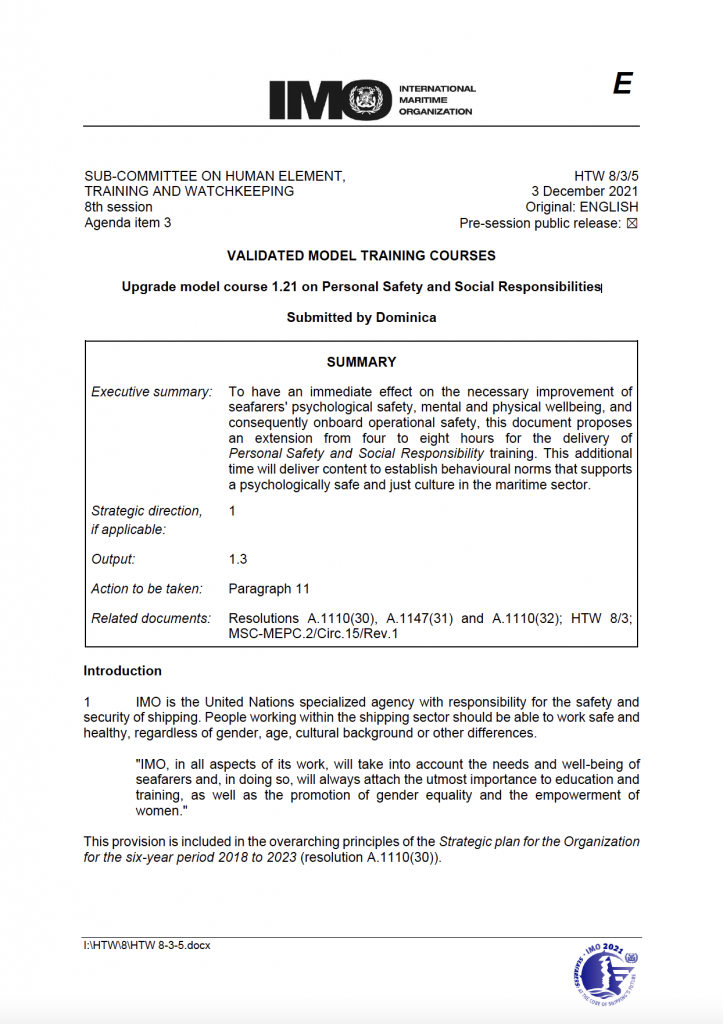
The Commonwealth of Dominica Maritime Registry submitted a paper to the eight session of IMO’s Sub-Committee of Human element, Training and Watchkeeping with a proposal to extend the delivery of the Personal Safety and Social Responsibility (PSSR) training from four to eight hours. The additional time will deliver content to establish behavioural norms that supports a psychologically safe and just culture in the maritime sector.

Please access the document below:

Launch of a Landmark Revitalization Plan

Launch of a Landmark Revitalization Plan

TUES, FEBRUARY 1, 2022 | 1:30 PM ET

The launch and discussion of a landmark Revitalization Plan for US Maritime Trade, Commerce and Strategic Competition to support and assist in resolving America’s supply chain crisis, ensure maritime sovereignty and security, and revitalize maritime commerce.

Event Recap

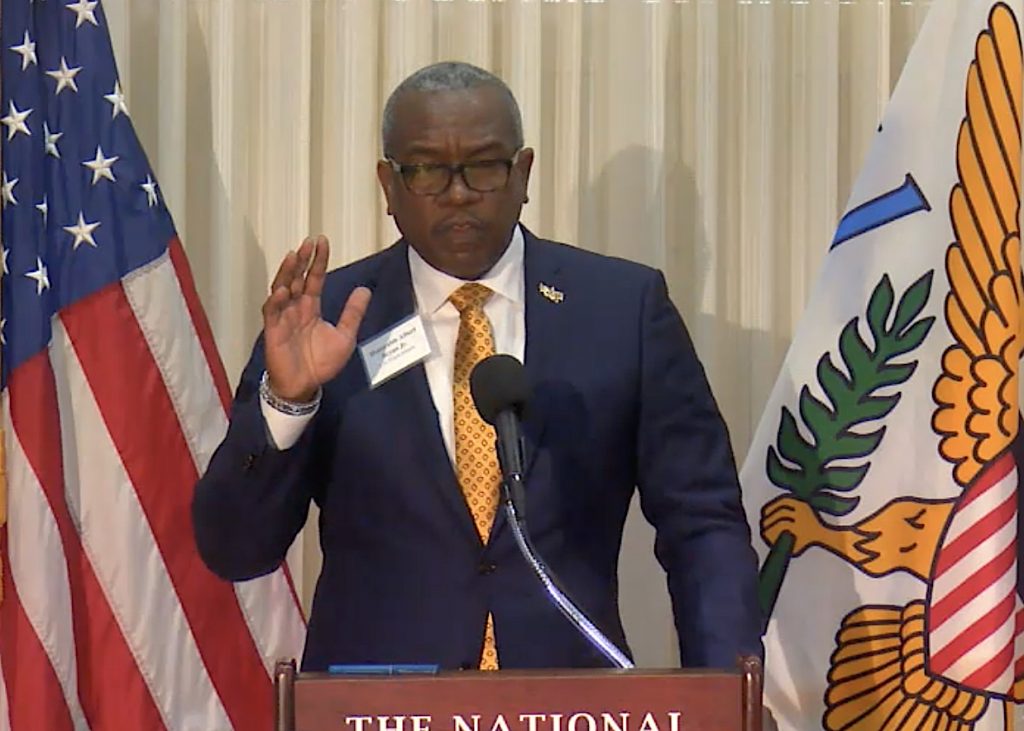
On February 1, 2022, at 1:30 PM ET, the Northeast Maritime Institute – Center for Ocean Policy and Economics (COPE) organized an event at the National Press Club in Washington, D.C., for the launch and discussion of a landmark Revitalization Plan for US Maritime Trade, Commerce and Strategic Competition to support and assist in resolving America’s supply chain crisis, ensure maritime sovereignty and security, and revitalize maritime commerce.

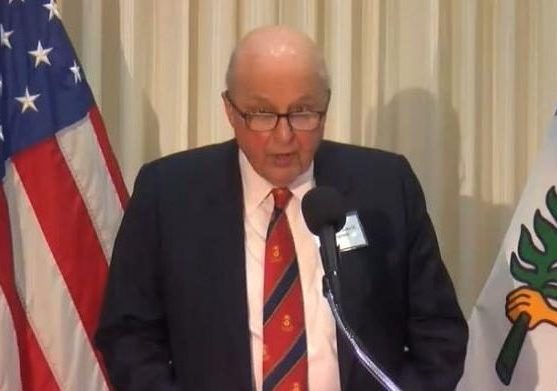
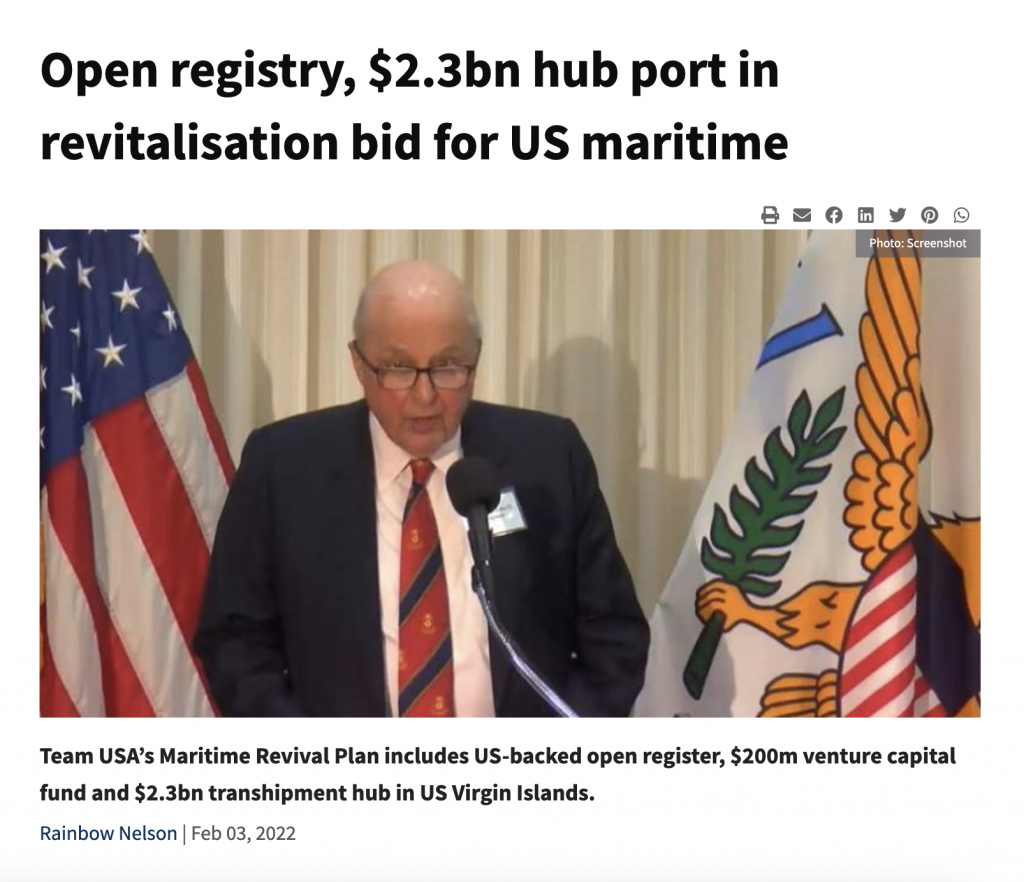
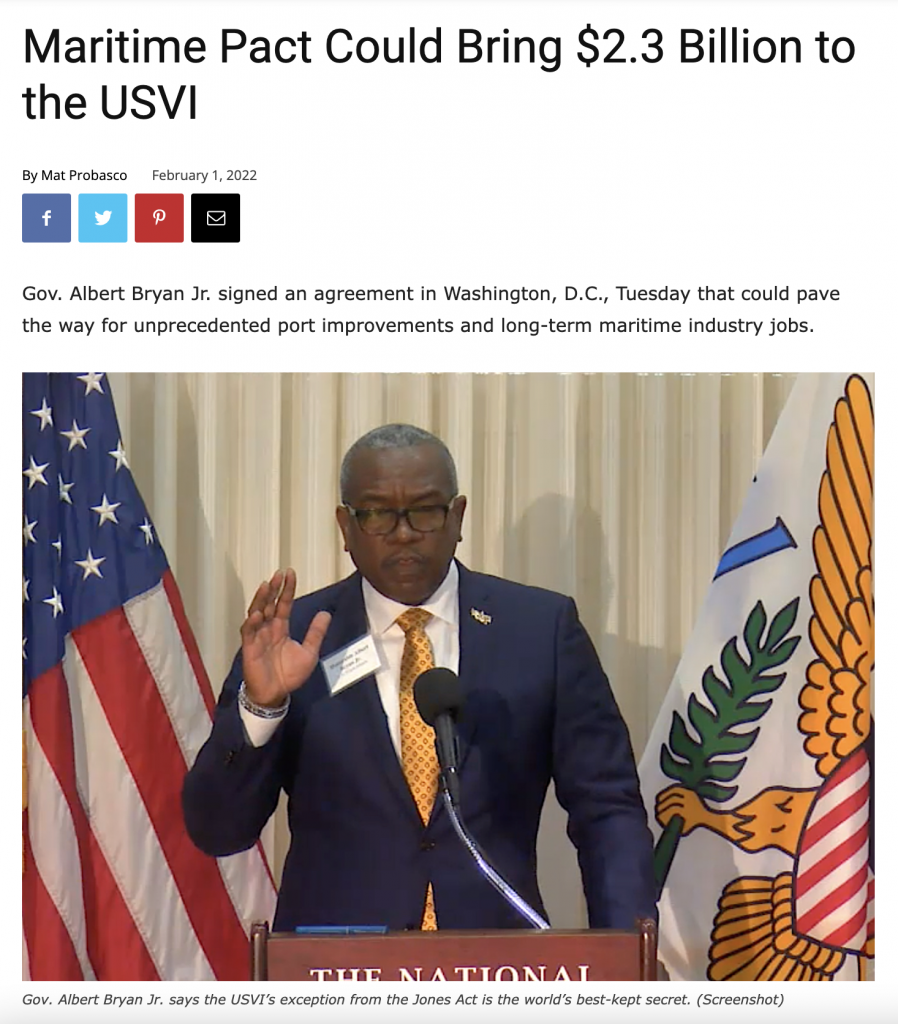
The event featured remarks by Ambassador John D. Negroponte, the first U.S. Director of National Intelligence and former Deputy Secretary of State; the Governor of the U.S. Virgin Islands, the Honorable Albert Bryan, Jr.; and President Eric R. Dawicki of the Northeast Maritime Institute.

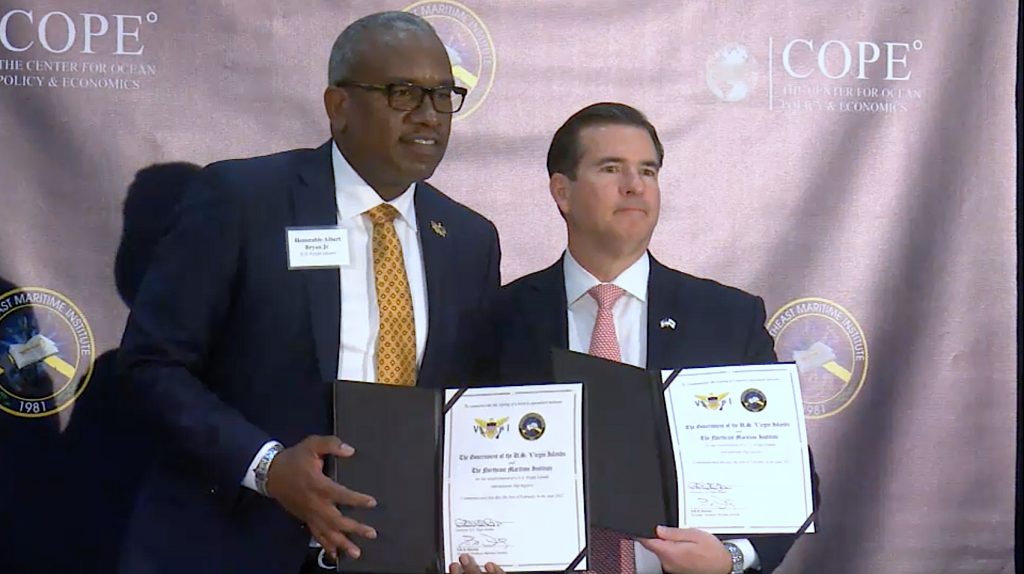
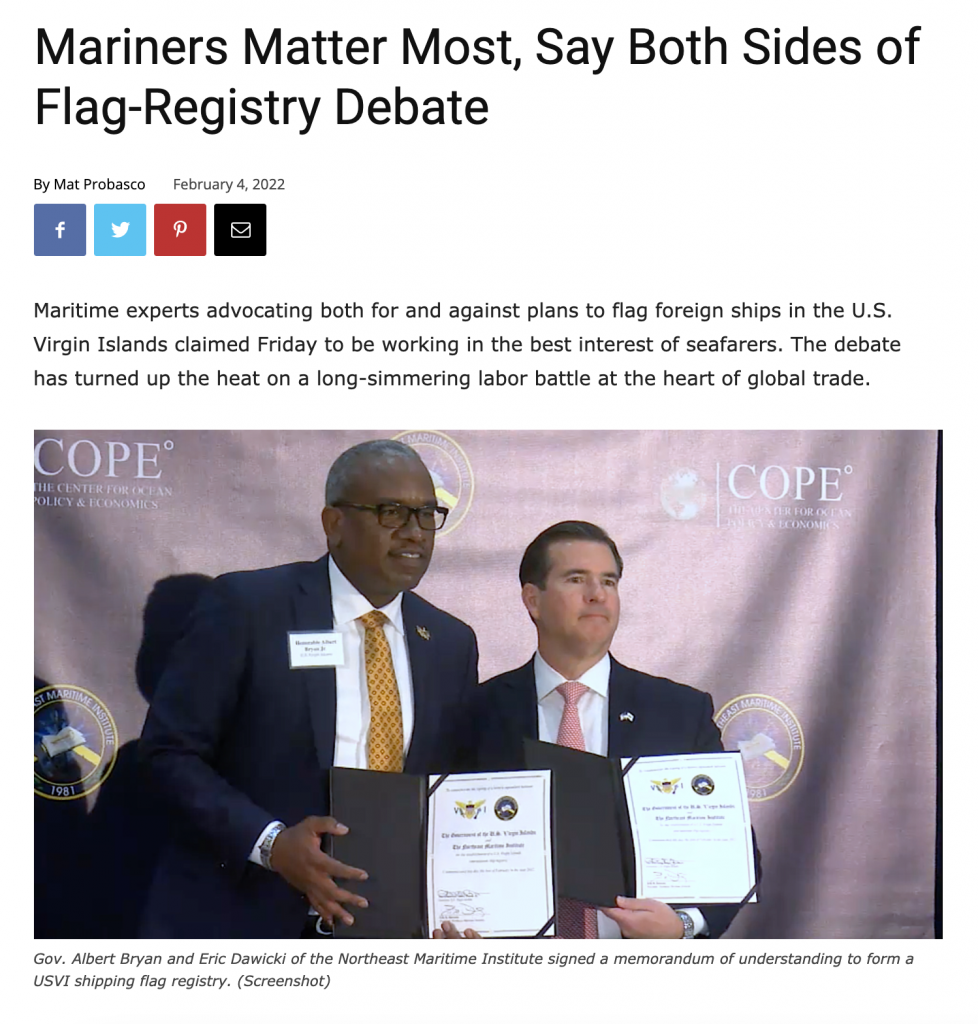
Following initial remarks outlining the Revitalization Plan, as well as the signing of a historic agreement between the U.S. Virgin Islands and Northeast Maritime Institute by Governor Bryan and President Dawicki, there was a panel discussion. Panel participants included Stephen Flynn, PhD, Founding Director of the Center for Global Resilience at Northeastern University, leading Homeland Security advisor under the Bush and Obama administrations, and global expert on supply chain resilience; Admiral James Watson, Northeast Maritime Institute Trustee and former Director of Prevention Policy for Marine Safety, Security and Stewardship at the United States Coast Guard and the first Director of the Bureau of Safety and Environmental Enforcement at the US Department of Interior; Captain Anuj Chopra, Co-Founder & CEO of FNI ESGPlus; Carleen Lyden Walker, Co-Founder and Executive Director of the North American Marine Environment Protection Association; and Captain John Konrad, Founder and CEO of gCaptain.

Additional commentary was provided by Nishan Degnarain, former Chairman of the World Economic Forum – Global Agenda Council on Oceans; Jonathan Kempe, Verifai Australia; and Dr. Sal Mercogliano, PhD, Campbell University. These remarks covered topics such as decarbonization of shipping, capital investment in new technologies, supply chain security, transparency in shipping, economic growth opportunities, the status of the US maritime industry, US national security interests, and more.

The event outlined how implementation of the Revitalization Plan for US Maritime Trade, Commerce and Strategic Competition will provide economic stability and environmental protection, as well as revitalize the position of the United States as a major competitor in international maritime trade and commerce while enhancing national security, both domestically and internationally.

A Revitalization Plan for US Maritime Trade, Commerce and Strategic Competition was developed by a team of Distinguished Fellows at the Northeast Maritime Institute – Center for Ocean Policy and Economics (COPE) and advised by an array of leading thinkers in the maritime industry. Key elements of the plan include:

  • Formation of the US Virgin Islands’ open international ship registry—the first, and only, international US open ship registry.
  • Development of a short sea transshipment hub in the Caribbean to alleviate supply chain congestion by moving a portion of east coast distribution from land to sea and increasing the number of ports importing ever-increasing quantities of goods from overseas.
  • Build public/private/international partnerships to address strategic maritime issues, increase transparency and enforce legal and ethical standards.
  • Establish and implement a green shipping strategy, including decarbonization of the U.S.-flagged fleet.
  • Establishing a Maritime Venture Capital Fund to finance commercially advanced technologies that solve maritime and ocean industry problems with a focus on environmental vulnerabilities.
  • Modernization of the maritime workforce by deploying state of the art education and training tools in the US and abroad.

Welcoming Remarks by

Morgan G. Dawicki

Speakers

Ambassador John D. Negroponte

Former U.S. Director of National Intelligence
Former Deputy Secretary of State

The Honorable Albert Bryan, Jr.

The Governor of the U.S. Virgin Islands

President Eric R. Dawicki

Northeast Maritime Institute

Moderator

Carleen Lyden Walker

Co-Founder and Executive Director of the North American Marine Environment Protection Association

Panelists

Stephen Flynn, PhD

Founding Director of the Center for Global Resilience at Northeastern University

Admiral James Watson

Northeast Maritime Institute

Captain Anuj Chopra

Co-Founder & CEO of FNI ESGPlus

Captain John Konrad

Founder and CEO of gCaptain

Northeast Maritime Institute

Event Resources

Revitalization Plan

A Revitalization Plan for U.S. Maritime Trade, Commerce, and Strategic Competition

A Revitalization Plan for U.S. Maritime Trade, Commerce, and Strategic Competition

A Revitalization Plan for U.S. Maritime Trade, Commerce, and Strategic Competition, developed by the Northeast Maritime Institute – Center for Ocean Policy and Economics, provides short, medium, and long-term solutions and benefits for the United States. The Revitalization Plan delivers positive national security, trade, sovereign capability, and sustainability outcomes through maritime initiatives. The Plan provides a framework for a coherent and comprehensive national maritime strategy that protects both domestic capacity and enhances international operations. 

Proposed Activity Items

Launch Open International U.S. Flag

Immediately establish an open international U.S. flag in the U.S. Virgin Islands (USVI) to provide responsible and transparent oversight to a commercial fleet of foreign and domestically owned and operated vessels.

Modernize Maritime Workforce

Rapidly deploy modern maritime education and training methods in the U.S. and abroad—including in-person, online, mixed-reality and simulator training—to attract new talent and upskill existing maritime workers.

Establish Short Sea Transshipment Hub

Immediately begin construction of a secure, high-throughput, and technologically advanced transshipment hub in the USVI, to increase U.S. trade capacity and resiliency, with an emphasis on secure cargo and efficient, sustainable short sea shipping.

Establish and Implement Green Shipping Strategy

Establish a National Maritime Sustainability Strategy including Green Maritime Highways and a Green Shipping Certification Program for USVI-Flagged Vessels, with requirements and benchmarks for environmentally sustainable construction, operation, management, and planning.

Build Public-Private-International Partnerships

Partner with U.S. interagency counterparts as well as international organizations and collaborators to develop new technologies and a specific set of measurement and assessment tools to address strategic maritime issues, increase transparency, and enforce legal and ethical standards.

Create a Maritime Venture Capital Fund

Establish a Maritime Venture Capital Fund (MVCF) to rapidly build commercially successful solutions that are technologically innovative, economically viable, and globally deployable with a goal of solving maritime and ocean industry problems with a focus on ecological sustainability.

Supporting Documents

The Development of The COPE° Fund

The Development of The COPE° Fund

The Center for Ocean Policy and Economics – The COPE° Fund will serve as the Endowment Fund and will be established to serve as a funding mechanism to new and relevant ocean science, technology and engineering opportunities that fit within the mission of COPE°. The original idea of the fund is that the great science and technology can be developed, implemented, and commercialized in a way that will create profit centers, jobs and sustainable practices that have a greater social ROI than traditional investment methodologies. The COPE° Fund will be established as a $200,000,000 fund. Commercialization funds will be established for projects that are selected after three layers of vetting that starts with: Problem Solving and Relevance, Operational Implementation, and Commercialization Plan.

The COPE° Fund will include a private capital think tank, established to work through the fund or directly with outside private equity and venture capital firms, institutional investors and governments around the world to foster the commercialization and entrepreneurial implementation of ocean science, technology or engineering. It will create new companies through accepting applications that meet our standard of compliance, relevance, and commercial viability. The COPE° Fund will take an equity position, provide management and mentorship support and operational input to ensure that projects realize the best possible opportunities for successful start-up, implementation, and contiguous operations.

Plans must be ready to drive commercial results within a two-year time frame and have long-term solutions that change or reverse adverse environmental conditions. Using a commercialization strategy like the DARPA model, scientists must be willing to create meaningful and impactful projects that not only reveal issues but create economically scalable solutions. Commercialization will assist in replenishing and growing the fund to continuously generate new and innovate scientific projects.

juega gratis a fruit snap en modo demo campobet casino mx resena casino porto pi lucky wheel bingo casino resena slots shine casino resena bbin flirting scholar dr slot casino resena es pagos mercadopago zebra wins casino de resena dhoniwin casino resena mx betway como registrarse metodos de pago paycash mx betway promocion pago anticipado se duplico el interes por los esports en espana durante 2024 blackjack 21 trucos ocean blue casino bono sin depsito 50 giros gratis 2025 betsson casino cl resena betfred casino es resena usa pensilvania betmgm casino jackpot capital casino resena pe nuevos casinos tabla de pagos ruleta europea 98647 trucos para ganar la ruleta en el casino 13136 juega gratis a 100 burning hot en modo demo belatra 5 wild wild peppers mr green casino se resena